Accredited
Confronts the reality that credentials still matter and the elite signal is concentrating, and lays out what a new kind of accredited college could look like: one where the portfolio is the degree, the platform is the campus, and price is no longer a wall.
Published July 4, 2026

Accreditation matters.
To be accredited is to be qualified or verified by a higher authority.
As my pastor, Rick Wilkerson Jr., said in a sermon titled Accredited,
"I don't want a dentist who has vibes. I don't need a lawyer who's self-certified. How are you qualified? Who verified you? By what authority do you come? We live in a world right now where people want influence without accreditation."
That is exactly right.
We live in a world that loves to pretend credentials no longer matter. Tech companies dropped degree requirements. Op-eds declared the diploma dead. Everyone repeated the same phrase: talent is everywhere.
For a few years, it looked like the signal of accreditation was weakening. In reality, it was concentrating. A January 2026 Fortune article, drawing on a survey of more than 150 companies by Veris Insights, reported that 26% of companies were now recruiting exclusively from a shortlist of schools, up from 17% in 2022. McKinsey, which had publicly expanded its recruiting beyond the Ivy League after 2020, quietly removed that language from its career page. GE Appliances used to send recruiters to 50 schools a year. Now they attend events at 15. The implication: Where you went to college matters more today than it did in 2022.
College is still the single best mechanism for lifting people into a higher socioeconomic strata. Raj Chetty and the team at Opportunity Insights linked tax records to college attendance for over 30 million American students. They found that, once a student arrives at a given college, kids from poor families and kids from rich families end up earning roughly the same amount. The college closes the gap. The problem is not that low-income kids fail when they get in. The problem is that they don't get in. Children whose parents are in the top 1% of the income distribution are 77 times more likely to attend an Ivy League college than children whose parents are in the bottom income quintile.
The earnings premium is also real, and it is large. A bachelor's degree holder aged 22 to 27 has a median income of about $60,000. A high school graduate of the same age earns about $36,000. That gap compounds across a forty-year career. For Harvard's Class of 2024, over 40% of employed graduates expected starting salaries above $110,000. Of the seniors heading into tech, almost half started above $130,000. This is what college does at its best. It moves people up. It is the most reliable engine of social mobility humans have ever built.
College works. That is exactly why its failure is so dangerous. The problem is that it still matters enormously, while the bargain underneath it is beginning to break. I recently saw a retweet by Chamath Palihapitiya. Chris King had written:
“The jig is up. The student loan racket has ran its course. 35 yr run. Not to bad. College was once for the best of the best. We dumbed it down. Invited everyone. And told millions of kids to borrow money to get a bullshit degree. What a joke.”
Chamath’s reply was one word: “This.”
Chris King was criticizing college while showing that he doesn’t know when to use “run” instead of “ran” or “too” instead of “to.” All jokes aside, he was pointing at something real. The conclusion is wrong.
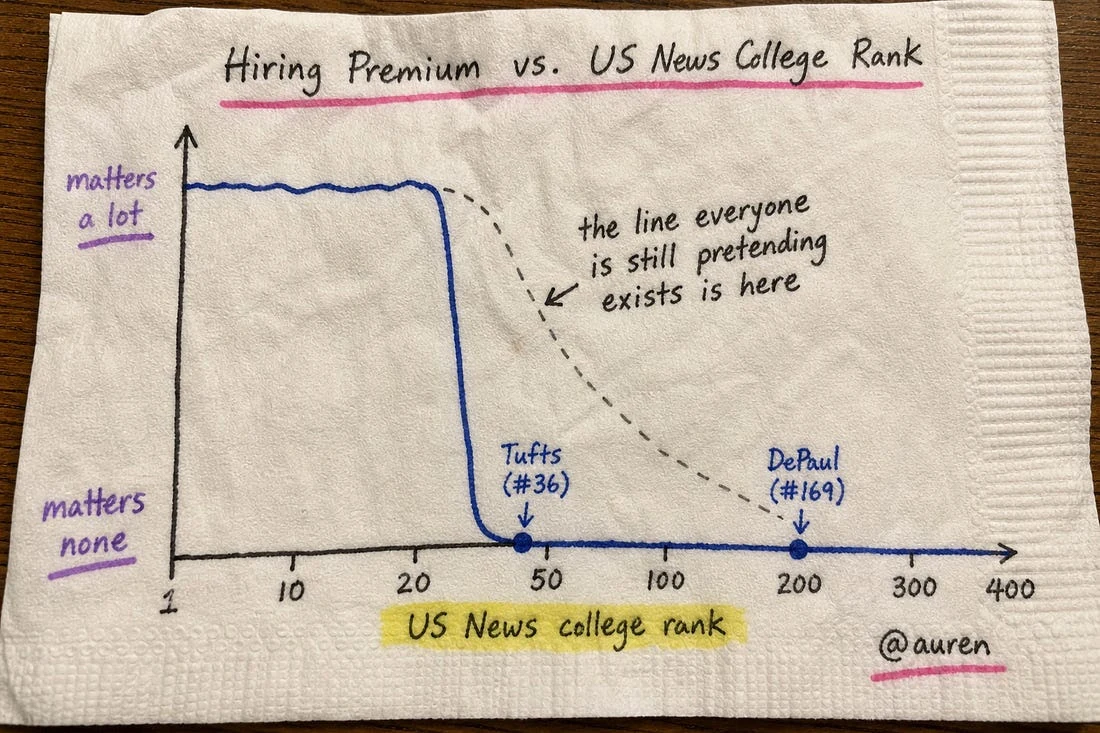
Yes, outside that narrow circle of elite schools, families are paying extraordinary prices for degrees whose value means less and less. At the very top, the signal is stronger than ever. The elite schools still open doors. Beyond that small circle, the signal is getting weaker. Auren Hoffman made this point bluntly in a Substack essay titled, “if you can’t get a job today, it’s your fault.” “the high schooler who worked their tail off to get into Tufts University (currently #36 in US News) has basically no real job-market advantage over the student at DePaul University (currently #169).”
“paying $80K a year for a brand that no longer carries any hiring premium is one of the worst trades in the consumer economy. and that trade is being made by hundreds of thousands of families per year who never got the memo.”
That is the first crack in the bargain. College is still the greatest engine of social mobility we have, but for too many people, the math of attending no longer makes sense.
The second crack is even more important. Even when students do everything right, many are being prepared for a world that no longer exists. This year, the commencement speaker at the University of Central Florida’s College of Arts and Humanities stood in front of a graduating class and said: "The rise of artificial intelligence is the next industrial revolution." The crowd booed. Someone shouted, "AI sucks." The speaker kept going. A moment later she said, "Only a few years ago, AI was not a factor in our lives." The crowd cheered. A week later, Eric Schmidt was booed for nearly the entirety of his commencement speech on AI. It was the fourth in a series of such incidents.
People do not hate something that much unless they feel threatened by it. These students had done what they were told to do. They went to college. They took on the debt. They earned the degree. And then they entered a world where the most important technology of their lifetime seemed ready to take their jobs. As one student put it, “I’m worried I’ll be homeless when I’m 25.”
That is not their failure. That is the failure of the institution that prepared them.
A few days later, I sat down with a group of high school students at Alpha School. They were power users of AI. One of them had used AI to build the school's AP prep software. Every student in his class used it. The majority scored a 5 on that AP exam. I asked them whether they were scared of AI. Their answer: "Why would I be scared? This is the most powerful tool in the world and I can do anything I want with it."
Those high schoolers are going to take the jobs of those college graduates. The job of a university today is not to teach students to hate AI. It is to teach them to wield it, so they can face the world like those high school students are. With the confidence that the most powerful tool in the world belongs in their hands.
College is still the single best place to prepare someone for the workforce. That is why the crumbling of its foundation is one of the greatest risks I see to a thriving American future. It is also why we focus so much on college at Endless. If we want a massive, thriving workforce, we have to make the pinnacle of education more affordable, and we have to teach the things that will actually get people hired in 2030. Everything else follows.
The New College
Auren Hoffman is right about one thing: "the new resume is something you built."
That is the clue to what college has to become.
As Auren puts it, "every hiring manager would rather interview a 22 year old with a launched app and a github full of weird side projects than a 22 year old with a 3.9 GPA from a top 50 school. it is not close. when one candidate has tangible evidence of what they can ship and the other has a transcript, the transcript will lose every time."
What would it look like to build a college that acknowledges this? A college where the degree and the portfolio are not competing signals, but the same thing? The answer is not to replace college. It is to rebuild what college accredits. Not attendance and tests. But proof of what a student can actually make. The portfolio becomes the degree.
A student does not learn to ship software by reading chapters about software. They learn by shipping. They learn by breaking something, getting stuck, asking for help, fixing it, and then doing it again next week with something harder. The job of the college is to put them in the conditions where that loop runs constantly, in front of people they respect, on work that real people will use.
So the curriculum is not a list of courses. It is a body of work. Every student leaves with a portfolio. Games shipped. Products designed and launched. Tools built. Small companies started. Bounties completed for real studios. Every piece is timestamped, peer-reviewed, mentor-reviewed, and visible.
Inside that portfolio you find the skills that matter in the age of AI. How to design a product. How to build a prototype. How to use the AI pipelines that the best teams in the world are using right now. How to use the software that industry actually runs on. How to take a thing from an idea to a working version to a launch. How to listen to a user. How to iterate. How to find product-market fit. How to do it again. Entrepreneurship is not taught as an elective. It is the structure of the school itself.
We are building for every discipline what GitHub built for software engineers. More on that shortly.
It works because of network effects, the same ones that built GitHub and YouTube and Wikipedia and Roblox. More students means more projects. More projects means more places for newer students to plug in. More contributions means more feedback. More feedback means better learning. More mentors emerge from the ranks of advanced students who teach the next class. More data flows into the AI that guides each learner through their next move. The platform gets better with every person who joins.
It works because of AI, which becomes the infinite mentor. Every student gets a tutor. Every project gets a code review. Every piece of art gets a critique. Every interview, every career suggestion, every "what should I try next" is available at midnight in any time zone. The AI does not replace human mentors. It lets each human mentor support ten times the students they otherwise could.
It works because the best content already exists. We do not need to film another intro to programming. The world's best teachers have already filmed them. The classroom stops being where the lecture happens. The classroom becomes where students review each other's work, debug each other's projects, and prepare for what they will build next week.
It works because the projects are real. A student is not building a fake game to satisfy a fake assignment. The student is shipping into a real studio's pipeline, competing in a bounty with thousands of other contributors, or running a small thing that has actual customers. Real stakes change the quality of the learning. Always.
And it works because the price collapses. All of this costs almost nothing to run. It's a software platform, like LinkedIn and GitHub. When students earn while they learn, when peer feedback replaces armies of teaching assistants, when AI does what a thousand graders used to do, the cost of running the school drops to a fraction of what a traditional college costs. Pick a number. Ninety-nine dollars a month. Much of it earnable on the platform itself for any student who shows up and contributes, as a mentor or a contributor to real products. The price stops being a wall. Everyone can join.
Put it together and you have a college that costs almost nothing, teaches what the AI economy actually rewards, and graduates students who have spent four years shipping real work to real people. That is the new college.
The Sorting Hat
In Harry Potter, when a new student arrives at Hogwarts, they sit on a stool and someone places a magical hat on their head. The hat thinks for a moment, then shouts out one of four houses. Gryffindor. Ravenclaw. Hufflepuff. Slytherin. Once you know a student's house, you know something real about them. Brave. Clever. Loyal. Ambitious. The sorting hat is fast, public, and surprisingly informative. College is the sorting hat for the muggle world.
Bryan Caplan's The Case Against Education argues that college does not so much teach students as sort them. Its real job is to signal to employers a "trinity of intelligence, conscientiousness, and conformity." Where you went and what you majored in tells a hiring manager more about you than four years of coursework ever could. The diploma is the hat's verdict. Caplan is partly right. Sorting is a huge part of what college does, and it matters. We recently hired an intern who grew up with a single mother, moved nine times, and was educated in Nevada, a state that ranks 48 out of 50 in educational quality in America. He took community college classes in high school so he could lift himself up, and then he got himself into Columbia, where he thrived. We hired him. If it had not been for Columbia, we never would have found him.
Why would we tear down the machine that lifted that teenager up?
But here is the thing. The sorting hat worked for him because he forced it to. For every kid like him who makes it to a Columbia or a Stanford, there are thousands who are every bit as capable and who never get sorted into anything at all. The current system finds the strivers who breach its walls. It misses everyone else.
The hat only gives you one word. The diploma only gives you a few. And the hat is only placed on the heads of students who already made it to Hogwarts. Now imagine a sorting hat with a million data points.
A hiring manager today opens LinkedIn and sees a resume. A hiring manager in 2030 opens our platform and sees the work itself. They are not reading a diploma. They are reading a person. They can search by discipline. The best 3D character artist in West Africa. The best gameplay programmer in Southeast Asia. The best narrative designer who learned English as a third language. They can rank by quantitative measures. Commits merged. Deadlines hit. Output over time. They can rank by qualitative ones. Reliability. Judgment. Kindness in a code review. What it is like to be in the room with this person at hour twelve of a game jam.
This is already how the best companies in the world hire. Silicon Valley engineers are found through GitHub. Big tech and quant firms hire through competitive programming, LeetCode, and Kaggle. They figured out long ago that high-volume, data-rich platforms produce better hires than credentials do. We are bringing that mechanism to every discipline. Art. Writing. Product. Engineering. Narrative. Music. Production.
College sorted with a hat. The college of the future should sort with a portfolio of everything a student has ever made, alongside every person who has ever worked with them. The old credential told employers where a student went and their GPA. The new credential tells them who that student is with a million data points.
The Substrate
We believe that this is the new college. A real, accredited degree, like the best universities. Driven by practice. Portfolio. Mentorship at scale. Real work. Real feedback. Real signal. Open to anyone, anywhere, who is willing to build. And I want to be clear about what we are doing here. We are not trying to replace the institution of higher education. It is one of the most important pillars of modern society. We are trying to help it rebuild.
There are about 6,000 colleges in the United States. Some sit in the hills of rural Vermont. Some sit in the middle of Detroit. They are trying to modernize, trying to give their students a real shot at the next economy. Most of them are not Harvard. Most of them never will be. Most of them are also full of faculty who care, students who showed up, and admissions officers that admit that their greatest challenge is watching their enrollment numbers slide in real time as a generation decides the deal is no longer worth it. There are about 43 million Americans who started college and never finished a degree or certificate. They tried. The system failed them. The "great jig," in the language of the tweet, is being discovered, and they are the ones absorbing the blow. We want to help colleges attract and hold their students by giving those students something that feels like a future worth finishing for.
We want to give those colleges something to fight back with. A platform. A community. A methodology. A curriculum that a single faculty member can adopt because she saw it on the internet and thought it would help her students. A system the whole university can plug into across every major. A way for that small liberal arts college in Vermont to give its students the same project density, the same mentor network, the same AI-native tooling that a student at Stanford has down the road. A little of the pixie dust that makes Silicon Valley thrive, sprinkled out across the country.
I often say that the less we do, the more we can do. The more we can lean on others, the more people we can reach. The goal is to reach everyone, everywhere, who wants to be prepared for the AI economy. The only way to do that is through other people. Other faculty. Other deans. Other universities. Other countries. We are not the institution. We are the substrate that helps the institution work. Take the curriculum. Take the bounty board. Take the portfolio system. Plug it in. We are not precious about it.
And yet, we also need to show what this looks like in its most integrated form. If we can prove that there is gold here, we can enable even more people to adopt it. Hence, we are building the infrastructure to enable this with ASU.
ASU’s Endless Games And Learning Lab
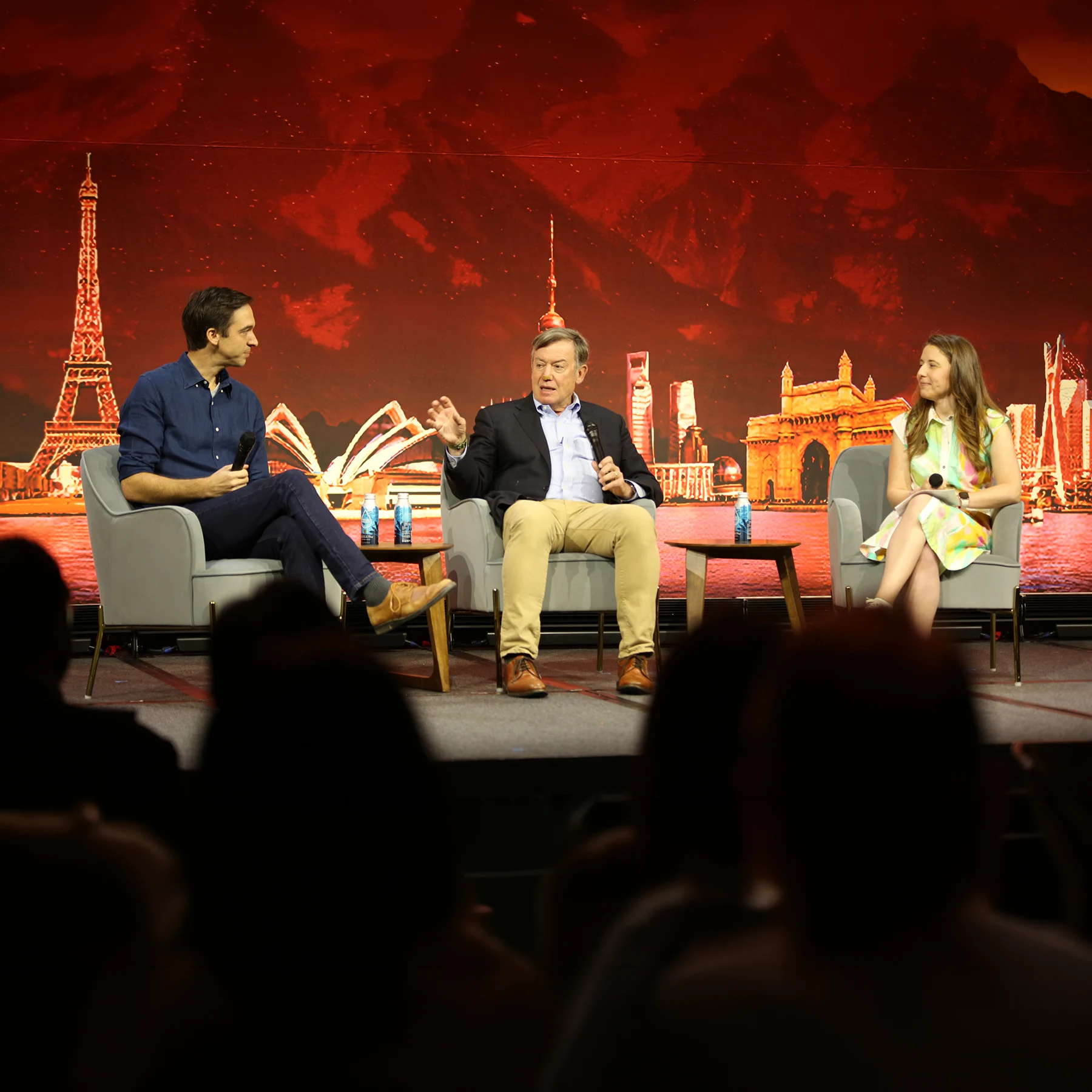
I heard about ASU and Michael Crow, perhaps the most famous university president in America, for years before I finally met him. When I finally got to sit down with him, it was a little bit like meeting a celebrity. He had heard about what we were doing and wanted to learn more about it. Within minutes, it was clear that I had met one of the only people I had ever met who believed in the power of games to teach as much as I did.
He immediately told me about all the time he had spent playing the game Spore and how it teaches you about evolution, and about the hours he had spent playing countless other games as a tactical mechanism to learn something very specific he wanted to learn.
It was clear that we were going to do something together. We had a vision that was not typical for academia. It needed to merge the academic rigor of a research lab with the design sensibility of a game studio and the business sensibility of a publisher. To move at the speed of a startup, but with the power of one of the largest universities in the world.
Together, we launched the Endless Games and Learning Lab at ASU. "The Endless Games and Learning Lab represents a whole new era in education," Michael said at the launch. "By merging cutting-edge technology and engaging game environments, the Endless Lab will redefine the future of games, learning and opportunity, and empower individuals and communities around the world."
We hired Mark Ollila, a veteran of the game industry who helped build the Nordic game ecosystem at Nokia, along with his wife, Elina Ollila, who was the UX designer on Candy Crush Saga. We all dove headlong into building games into the heart of education. The AME (Arts, Media and Engineering) program in the Herberger Institute for Design and the Arts added games and became the GAME School. They began partnering with Microsoft, with game studios in Africa, with Games for Change, with OpenAI, and they quickly started becoming one of the most exciting things happening in games and learning anywhere.
Today, ASU has launched a B.S. in game making. They run game jams across a network of universities. They are building a system that validates the learning that happens when students play games. They are bringing professional studios into the courses they teach. And most importantly, they are researching how to harness the engagement of game creation and the collaborative pull of community to build a degree program that is immersive, customized, and radically scalable. At a fraction of the cost. What a partner!
Rebuilding The Ivy Walls With Gates
Michael Crow rewrote the ASU charter around a single radical idea: that a university should be "measured not by whom it excludes, but by whom it includes and how they succeed." That sentence is the whole argument. The Ivy League brand is built on rejection rates. The New American University is built on the inverse. The answer is not to dismantle the institution of college. It is to democratize it. To upgrade it. To make it affordable. To ensure it keeps its promise of preparing young people for a better life, with a real return on the years and dollars they put in.
Imagine a system with millions of students, affordable to everyone, where the whip-smart kid in the broken public school can prove what she can do and the data shows it. Where any faculty member who cares can pull a curriculum off the shelf and run it on Monday morning. Where any university can plug in across every major and offer its students a credible path into the AI economy. That is the mission. Not to build one more college. To equip the six thousand colleges that already exist.
If more students build real products with the tools the most powerful AI users embrace, ship strong portfolios, have fun in the process, make things people actually use, then the AI transition stops feeling like something happening to them. It starts feeling like something they are doing. That is the difference between a generation that stands up in revolution, angry at the future that was stolen from them, and a generation that stands up to build a future, because we taught them to.
The American university is one of the most powerful institutions ever built. Silicon Valley was born out of Stanford. The internet was born out of universities. The intellectual horsepower that has made America the dominant economic and cultural force of the last century did not appear from nowhere. It came from a system that gathered brilliant young people together, gave them years to think, and pointed them at the hardest problems of their generation. That is not a system we should tear down. The world seems to increasingly agree with Chris and Chamath that we should. They are wrong.
This is a system we should defend. We can defend it by helping it adapt.
Now the question is how we reach the corners we cannot reach ourselves.