The Teacher of Silicon Valley
Tells the story of Esther Wojcicki's Palo Alto media program, where students run real publications as student startups, as a working proof that project-based, hot-group learning produces creators rather than test-takers.
Published July 4, 2026
PRINCIPLE: Every student needs authentic entrepreneurial experience, not just theory.
Maria Montessori said, “The greatest sign of success for a teacher... is to be able to say, ‘The children are now working as if I did not exist.’”
Theory is valuable, but seeing these principles in action brings them to life. Let's examine what these models might actually look like when implemented in a classroom, not as abstract ideals, but as tested, proven approaches that have produced remarkable results for decades.
Esther Wojcicki is a bit of a Silicon Valley legend. She has so many stories of serendipity that sometimes I feel like I am talking to a highly intelligent Forrest Gump. Back in the late 1990s, her daughter Anne was dating a PhD student from Stanford who, along with his research partner, was working on a new search algorithm. Anne convinced her parents to let these two young computer scientists set up a small headquarters in their house. Before long, Esther's garage was spilling over with computers and servers weaving a web of wires around her home. Few could have guessed that this garage operation would eventually become Google, or that Sergey Brin would one day be her son-in-law.
A few years earlier, a Stanford researcher put a marshmallow in front of 4-year-old children and told them that the teacher was going to step out of the room. They were instructed that they could not eat the marshmallow while the teacher was gone, but that they could have two marshmallows if they waited until the teacher came back. This now famous Marshmallow Test showed an astonishing correlation between this little test of willpower at age four and measures of success later in life. It turns out that the original Marshmallow test was conducted at her other daughter's school. Her daughter was one of the participants. In fact, Susan waited longer for the marshmallow than anyone else in the class.
But it wasn't the small world stories that made her the teacher of Silicon Valley. As she puts it, "I'm just a teacher." Her insights as a teacher are what I want to write about.
Born Of Rigidity
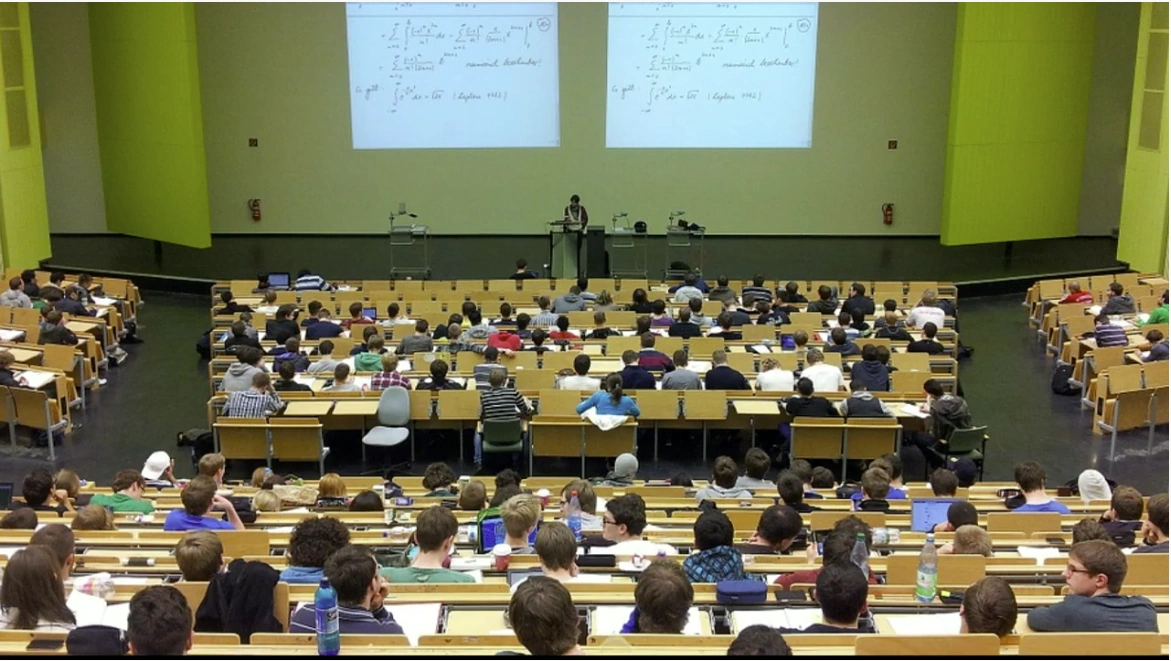
Esther started teaching at Palo Alto High School in 1984. There were 19 students in her media and journalism class. A year in, she saw all the ways the school system was completely broken. The schools were lining kids up in rows and having them sit quietly for days upon end.
Schools were preparing students who were good at following instructions, students who were adept at taking tests and students whose only goal was to get into college. The result was students who could ace an exam, but weren't innovative and creative. But employers are looking for creative employees, critical thinkers, good communicators, good collaborators and independent learners.
People learn by doing and by interacting. Esther asks, "Can you imagine learning to ride a bike just by watching someone else do it? Or how about learning to code by reading a book about it?" Einstein said that "Learning is an experience. Everything else is just information." Esther describes that in the old lecture model, "students learn about required subjects instead of learning through interest-based learning or experience." They need to learn through doing.
On the heels of her first year on the job, she decided that she had to either quit or throw away the textbook and hope the principal didn't fire her. She decided to do the latter and move from "the sage on the stage to the guide on the side." Nobody even noticed.
Until three years later, when her enrollment had tripled.
A few years later, Steve Jobs went to talk to her and interrogated her on her methodology. The next day, his daughter Lisa had transferred schools and was sitting in Esther's media arts class. Lisa went on to be the senior editor of the magazine, working alongside James Franco.
Esther's model was getting attention.
The Model
Her model is simple: give students a project that they care about and trust that they will pour their souls into it. In the process, they will learn the skills that are necessary to succeed in the future. In her media and journalism program, students aren't just learning about media. They're running actual startups. They are entrepreneurs, journalists and publishers. They start magazines, newspapers, radio, television shows and websites, all by themselves. She says, "I don't do anything other than teach the tools. They do everything."
There are effectively ten media startups in the school, all founded by students. These aren't simulations or theoretical exercises. They're real businesses with real deliverables and deadlines. Students run every aspect of each organization, from writing and designing to fundraising, selling advertising and publishing. Her philosophy for the media program is that project-based, collaborative learning is the best way to prepare them for the challenges they'll face as journalists and as adults.
They are doing the doing. Project-based learning.
Esther talks about how schools need to go from looking like this:
To looking more like this:
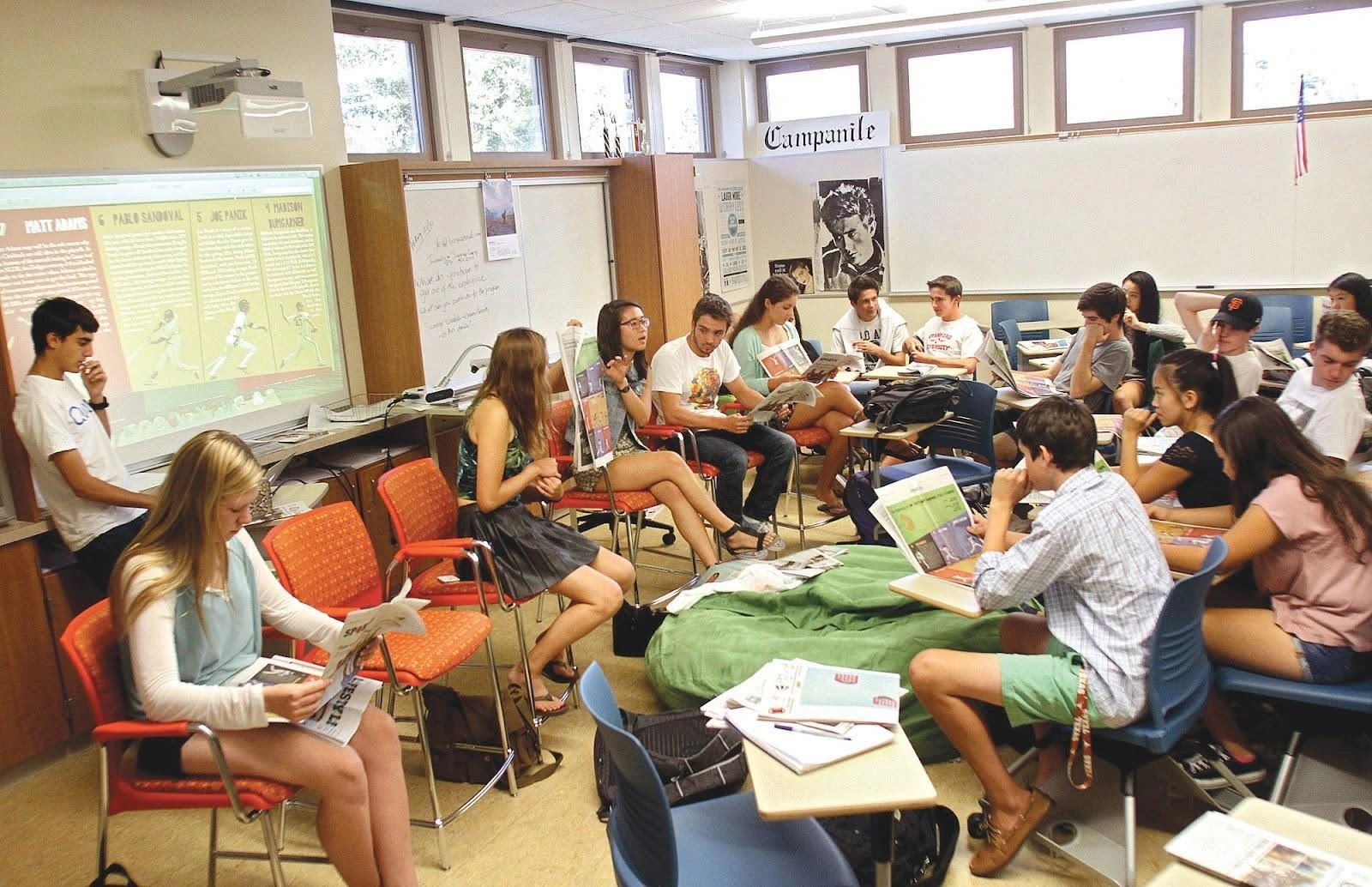
At Stanford's business school, the first week's orientation session talks a lot about Hot Groups. A Hot Group is "a lively, high-achieving, dedicated group, usually small, whose members are turned on to an exciting and challenging task. Hot groups, while they last, completely captivate their members, occupying their hearts and minds to the exclusion of almost everything else."
I just went to my 10-year reunion and someone asked me about my favorite memory there. The memory came very quickly, it was in a hot group in the final sprint on a project. That picture from Esther's class looks like my hot group, the pinnacle of my best educational experience.
I never had a hot group in high school, because I never had an exciting, challenging group task. Esther's model is about making hot groups the heart of an education by transforming the classroom into a startup incubator. These aren't pretend companies. They're functional media businesses that produce real products for real audiences. By bringing startups into schools, she creates an environment where students develop the mindset and skills of entrepreneurs while still in the safety net of an educational setting. Sitting in her class, you can't help but hope that it becomes the future. Certainly, I want it for my kids.
Legacy in Action
Esther's program is now the biggest scholastic journalism program in the nation. It has 800 students, ten publications and five other teachers. The city of Palo Alto voted to issue a tax bond to build a 25,000-square-foot Media Arts Center to house it. Esther is quick to describe that she ran these classes in trailers for decades. "Anyone can do this anywhere." Her class has 80 students in it, with one teacher. That teacher-to-student ratio is unheard of except for the poorest of developing countries, and yet it works because, "they are doing the work and I am facilitating the work." The massive building is just a reflection of the success of her model.
The proof of Esther's philosophy extends beyond her classroom. Her own daughters embody the principles she champions: trust, respect, independence, collaboration, and kindness. Susan, who showed remarkable self-control in the Marshmallow Test, later became the CEO of YouTube. Another daughter became a professor at UCSF medical school, while Anne, whose boyfriend once filled their family garage with servers, co-founded DNA testing pioneer 23andMe. When Esther published How To Raise Successful People, the title wasn't marketing. It was a statement of fact.
From Theory to Practice
Last month, I had breakfast with Esther in Silicon Valley. She reminded me of the time I flew to Argentina years ago to meet her and a woman I was dating. "I had to approve of Jenny," she joked. Now Jenny is my wife, and we spent that breakfast peppering Esther with parenting questions for our two children.
As I listened to her wisdom, I realized something profound: the educational principles that transformed her classroom are the same ones that transform families, companies, and communities. The gap between how we learn and how we live shouldn't exist. When we give people meaningful work, trust them to do it, and guide rather than dictate, they flourish, whether they're high school journalists, technology pioneers, or young children.
The traditional classroom prepares students for a world that no longer exists. Esther's model of "startups at school" prepares them for a world that demands creativity, collaboration, and adaptability. By running real ventures with real stakes, students develop the entrepreneurial mindset that the modern economy rewards. They learn to identify opportunities, manage resources, overcome obstacles, and deliver value, not as theoretical concepts, but as lived experience.
What if every school had a class that looked like Esther's? What if every student had the chance to build and run real ventures that matter? What if education wasn't preparation for entrepreneurship, but entrepreneurship itself?
These aren't just academic questions. They're the blueprint for a future worth building. The more I understand this model, the more urgently I feel we need to scale the experience of startups in schools. We've seen it work in Palo Alto's media center, in tech incubators within universities, and in programs that blur the lines between classroom and company. We know it's possible.
What's missing isn't proof. It's the will and a replicable formula. The will to reimagine our classrooms not as holding chambers for future workers, but as launchpads for present creators. And a formula that makes it accessible for teachers everywhere – not just the revolutionary ones like Esther – to bring this experience to their students systematically, reliably, and joyfully.
The future we need isn't one where entrepreneurship is taught; it's one where entrepreneurship is practiced, from the earliest moments of a lifelong journey.