Winter
Pairs Amalia Giger's 1914 diary from the Waldhaus hotel with present-day signals to depict what it actually looks like when a peaceful age tips into total war.
Published February 26, 2026
“Dulce bellum inexpertis.”
— Erasmus, 1515
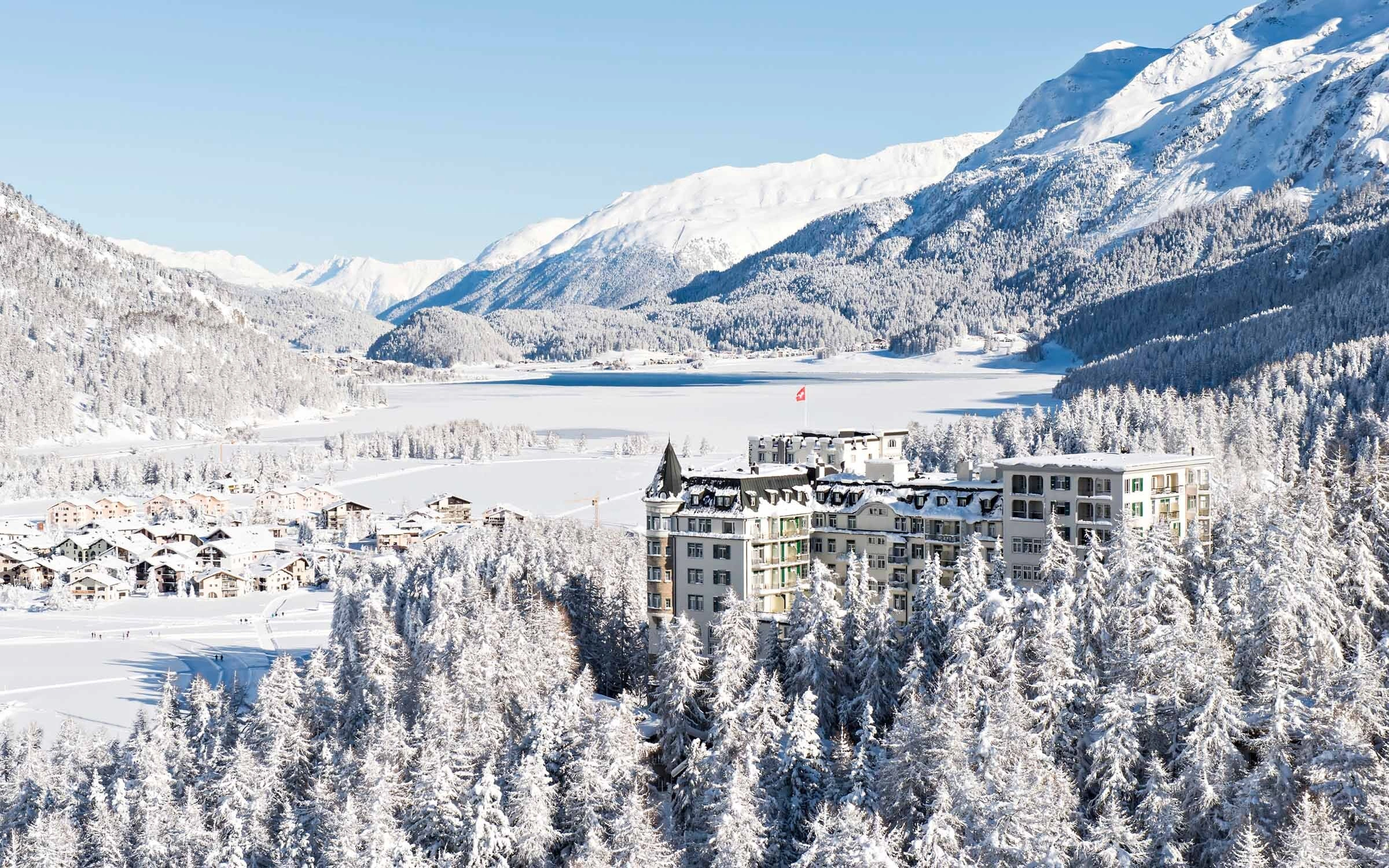
It’s Christmas and I'm in the Waldhaus hotel in Sils-Maria, high up in the Swiss Alps. I’m reading The Magic Mountain, written about a man in a Swiss sanatorium in 1907. The life it describes feels eerily identical to the life that I live here. The hotel has hardly changed since it was opened in 1877. And neither have its rhythms.
I often come down here in the early morning, hours before the hotel has woken up. I sit sipping my tea, reading this slow book, in awe of how little changes with time. The rite of the breakfast china softly clinking as the waiters arrange their morning table settings has been going on like a brook burbling over stones, running for generations. Sitting here in the glittering morning lights against the dark, I feel it. As if the hotel guests have been invited into a century-old agreement that we would not disturb the quiet whisper of the morning snow outside. As Nietzsche, who spent 8 years writing here, described this village, it is “6,000 ft beyond man and time.”
Hans, the character in the book, sits ruminating the same thoughts that we all sit with: "What is time? A mystery, a figment—and all-powerful."
Then the sound of thunder rumbles on the horizon. Another generation awakens. For soon, the shining stars would fall. Red roses placed by graves. The book is, as I summarized it for my family, 14 hours of reading about people dining in the Swiss Alps and then an hour in which World War I comes and they all die.
I discovered a series of diary entries written by Amalia Giger, the wife of the proprietor at the Waldhaus hotel I was staying in, written as World War I started. The diary begins with an image that feels almost like a photograph of civilization right before it breaks like china shoved from the table:
“The Waldhaus had more than 200 guests… Austrians, Hungarians, Russians, Britons, French, Belgians, Dutch, Americans and Italians — even a gentleman from Serbia — all still peacefully united just a few days before the war.”
Then the dates begin.
July 28, 1914. “When on July 28, the Austrians declared war on Serbia, our Austrian guests departed immediately, and from that day on, the weeping and wailing at the hotel did not stop.”
July 31. “When news came of Germany’s declaration of war on July 31… people took leave of their senses.”
August 1-2. “The army had to report for duty on August 2, and all horses had to be presented. Our carter, Mr. Meiser, had 120 horses to present, and he was only allowed to keep four.”
“In the first days after the declaration of war people lost their heads. Anyone who had an account at the banks, no matter how large or small, withdrew their savings, and this precipitate behavior brought the banks to the edge of ruin.”
“The same madness applied to the purchase of food. People had the impression that we were all going to starve this winter already.”
August 5. “The beautiful Waldhaus had to close its doors.”
From July 28 to August 5. A week. The orchestra is sent away. Nobody is in the mood for music. A lobby crowded with telegrams, a cashier without small bills, a stable emptied of horses, a hotel closing its doors.
This is what the beginning of war looks like.
September. “Today is Sept. 20… The European War is being waged with a savagery that I didn’t think possible in our much-praised age of progress.”
Our much-praised age of progress.
“Our civilization has once again broken down completely and in its modern form has proved to be no stronger than the civilization of the ancients.”
October. “The battlefields continue to expand and the military hospitals fill up at an incredible pace. How will this terrible world war ever end? Doctor Bernhard…wrote his family in St. Moritz that in his many years of practice he had never experienced or seen anything as horrific as what he had seen and experienced there. He only wished that those responsible for this war would have to spend 24 hours listening to the moaning and the sighs of the poor soldiers and see their tears and despair. Then they would surely think twice before going to war again.”
“Dulce bellum inexpertis. War is sweet to those who have not experienced it.”
I look up from the diary, scanning the living room in the hotel, guests sipping and smiling silently in a postcard-perfect Swiss dining room.
A question hangs in the air.
Would such a thing be possible in our much-praised age of progress?
Today
When Iran’s foreign minister was asked in an NBC interview whether he feared a US invasion, he answered with startling calm: “No. We are waiting for them.” The interviewer seemed unsure he had heard correctly. “You are waiting for the US military to invade with ground troops?” The minister replied, “Yes, because we are confident that we can confront them, and that would be a big disaster for them.” As Vali Nasr wrote, “Tehran has been preparing for this war for nearly four decades.”
China has also been preparing for the possibility. Xi Jinping has told the Chinese military to “prepare for the hundred year storm.” He has told them to “direct all energies to combat readiness.” He has told President Trump that the Taiwan question, if handled poorly, could lead to “an extremely dangerous situation.” China's leader does not use that language casually. He understands the historical gravity of the moment and is preparing for it. China has been driving steel into the foundations of its society, preparing for Winter.
There is a comforting story Americans tell themselves about how wars are won. It is a Top Gun story. The aircraft carrier sails into position. The fighters scream off the deck. The target is hit. The mission is accomplished. Maverick comes home. That is the opening salvo of a war. As we saw in Iran, it is not a war.
In The Fourth Turning Is Here, Neil Howe writes about wars in Third Turnings as “inconclusive”. Picture the wars we have known. Iraq. Afghanistan. Skirmishes far from home, fought by professionals, paid for with debt, watched on television. A small fraction of Americans serve. A smaller fraction die. The rest of us go to work.
The wars of the Fourth Turning are not those wars. They are total wars. Everyone is in them. Every factory, every supply chain, every citizen. These are the wars our grandparents and great-grandparents knew. These are the wars we have spent eighty years forgetting. These long wars are won by sheer industrial capacity.
Thomas Jefferson wrote, “if there be a rock on which we are to split, it is the want of muskets, bayonets and cartouch-boxes.”
Americans and Soviets outproduced Germany and Japan. They won because Henry Ford built the Willow Run plant, which produced a B-24 bomber every sixty-three minutes. Britain hung on by a thread until American manufacturing arrived. They won because Bletchley Park's codebreakers built the world's first programmable electronic computer to read Hitler's mail. They won because they beat him to the atomic bomb. They won because they made more and understood the math better.
Today, the question that should keep American strategists awake at night is simple. Who has the industrial capacity now?
A single Chinese shipbuilder in 2024 made more commercial vessels by tonnage than the entire US industry has since World War II. In 2023 China delivered 972 commercial ships, while the US delivered 7. China produces more steel in a month than the United States produces in a year. China graduates several times more engineers than the United States does. Last year China filed more patents in key strategic industries than the United States and Europe combined.
Nobody knows China's exact arsenal but what we do know is staggering. The PLA Rocket Force has a stockpile of approximately 600 nuclear warheads and what the Pentagon calls "the world's leading hypersonic missile arsenal." The YJ-21 anti-ship missile can close in on a carrier at Mach 10. Behind the navy stands a merchant fleet. China (including Hong Kong) has a fleet of 7,838 commercial ships. The United States flagged merchant fleet currently sits at 185. On Christmas Day 2025, roughly two thousand Chinese fishing boats in the East China Sea broke from their normal patterns and assembled into a reverse-L formation nearly three hundred miles long near Taiwan. They held their position for more than thirty hours in gale force winds. Cargo ships had to thread between them. Analysts call this the People's Armed Forces Maritime Militia. It was a Christmas card to Washington. A Yuletide greeting, hand-delivered while everyone was home drinking eggnog and opening presents.
These, however, are still the measures of old, conventional forms of warfare. Drones have radically altered the definition of war, from their decisive role in the Second Nagorno-Karabakh War in 2020 to the way they extended the wars in Ukraine and Iran. In the war in Ukraine, they now account for 96% of Russian casualties[^2]. In one year, Ukraine went from using around 3,000 drones per day to using 60,000 a day[^3]. Everything is exponential these days.
As the WSJ reported of a NATO exercise, “During one scenario, a battle group of several thousand troops… failed to account for how drones have made the battlefield more transparent.” It goes on, “A single team of some 10 Ukrainians, acting as the adversary, counterattacked the NATO forces. In about half a day they mock-destroyed 17 armored vehicles and conducted 30 “strikes” on other targets…[^4]”
These drones are increasingly shifting to ground robots. In Zelensky’s words, "For the first time in the history of this war, Ukraine has captured an enemy position using only ground robots and drones. The occupiers surrendered. The operation was carried out without infantry participation and with zero losses on our side."
If China retools, it can produce billions of drones using 1% of its civilian capacity. It can then load them onto ships that can hold millions of them each. The US Army, by comparison, plans to buy one million drones over the next two to three years, up from about 50,000 today.
My father, who has spent his life studying how empires rise and fall, has written about five major types of war that great powers fight when the old order is collapsing. “History has taught us that there are five major types of wars,” he writes. Trade and economic wars. Technology wars. Geopolitical wars. Capital wars. Military wars. They tend to come in that order. Each one a tightening of the screws.
You can map them onto the news of any given week. Tariffs and export bans. Trade war. Chip restrictions, the AI race, the scramble for rare earths and the data centers that will define the next century. Technology war. Taiwan, the South China Sea, the Persian Gulf, the Arctic, Ukraine. Geopolitical war. The dollar's reserve status, BRICS expansion, central banks buying gold at the highest rate in fifty years. Capital war.
Then comes the fifth. We are not in the fifth. Not yet.
The Turnings
I am not saying there will be war. But if Howe is right, the pressure we feel in our bones each day has to be released. Civil war, financial crash, great power war. Something breaks. The pressure is relieved. The new order begins.
The Fourth Turning runs about twenty to twenty-five years. If ours began with the financial crisis in 2008, the resolution arrives somewhere around 2032 to 2034. Maybe he’s right. Maybe it’s later. But it arrives. A handful of people in positions of extraordinary power will decide how. The rest of us will endure what they decide.
That sounds like the end of a story. It isn't.
As apocalyptic as the specter of a Fourth Turning looks, the reality is that life goes on beyond the crisis. So many previous turnings felt apocalyptic. Think of the scale of WWII, the threat of industrialized bombings and genocides, of global totalitarianism under Nazi Germany and Imperial Japan, and the atomic fear that followed the bombings of Hiroshima and Nagasaki. Think of how, eighty years later, Germany and Japan are the third and fourth largest economies in the world, and America's closest allies. The grandchildren of the men who killed each other at Stalingrad and Iwo Jima share trade agreements, classrooms, and Netflix queues.
That is the part of the story we forget when we are inside the storm.
I find it much more bearable to imagine a dark future ahead when I see that we just need to get through it. That it is a season. That sunshine awaits us on the other side. I have no illusion that we can change what happens in the next decade. The Fourth Turning will arrive on its own schedule. But the First Turning that follows is ours. Crisis might be inevitable. The world that comes after it is not. Whether we descend into chaos then or rebuild something better is the question this book is about. These chapters are about identifying what it takes to have a good future, so we can do it.
We know one thing: time will pass. We have to look past this moment. We have more agency in what comes next than we think. But we have to start building it now.