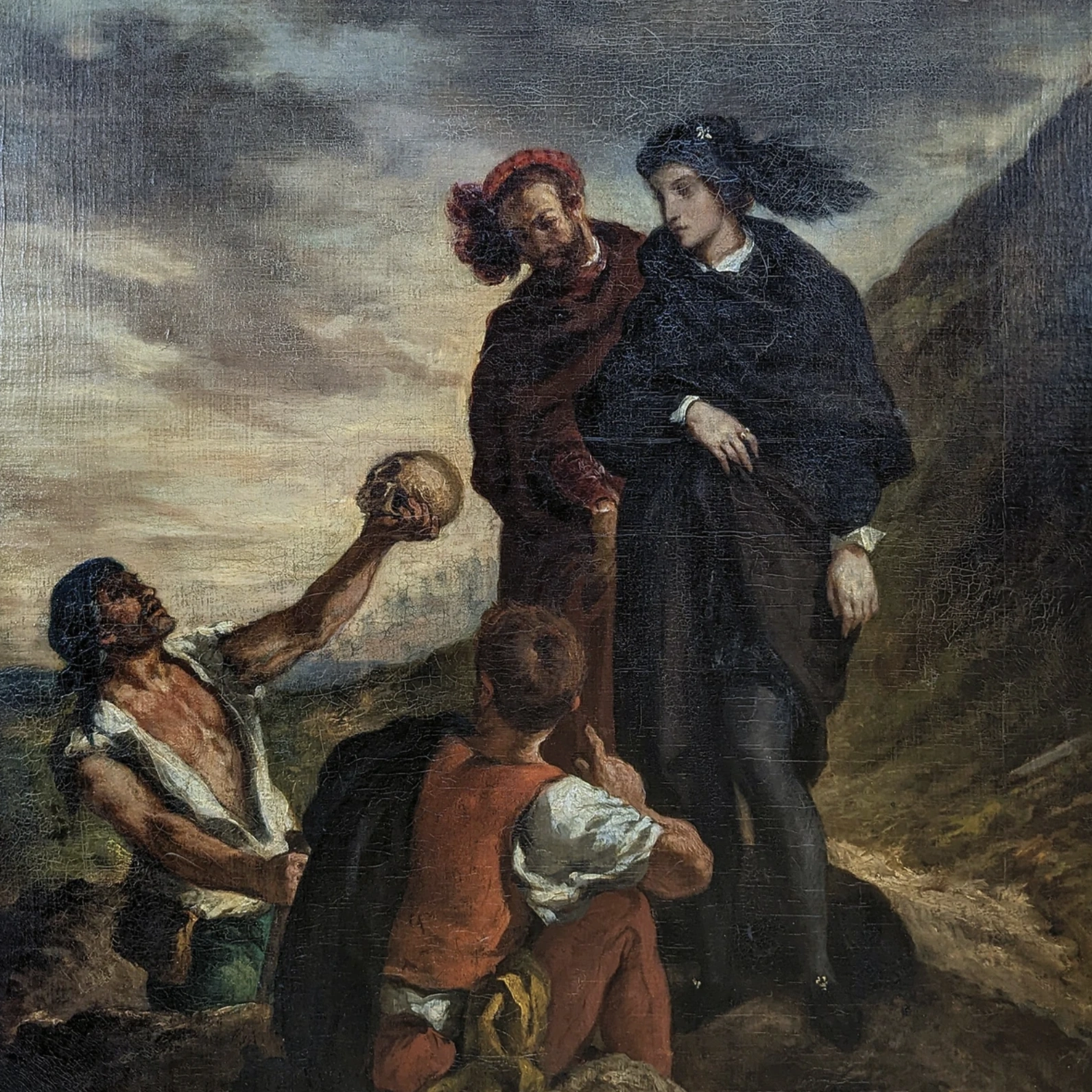
The Typing Monkeys
Opens Act 2 by doing the actual math on the monkeys-and-Shakespeare problem to argue that the upskilling of three billion young people cannot be left to chance and must be designed.
Published May 7, 2026
Principle: Some things cannot be left to chance. They have to be crafted.
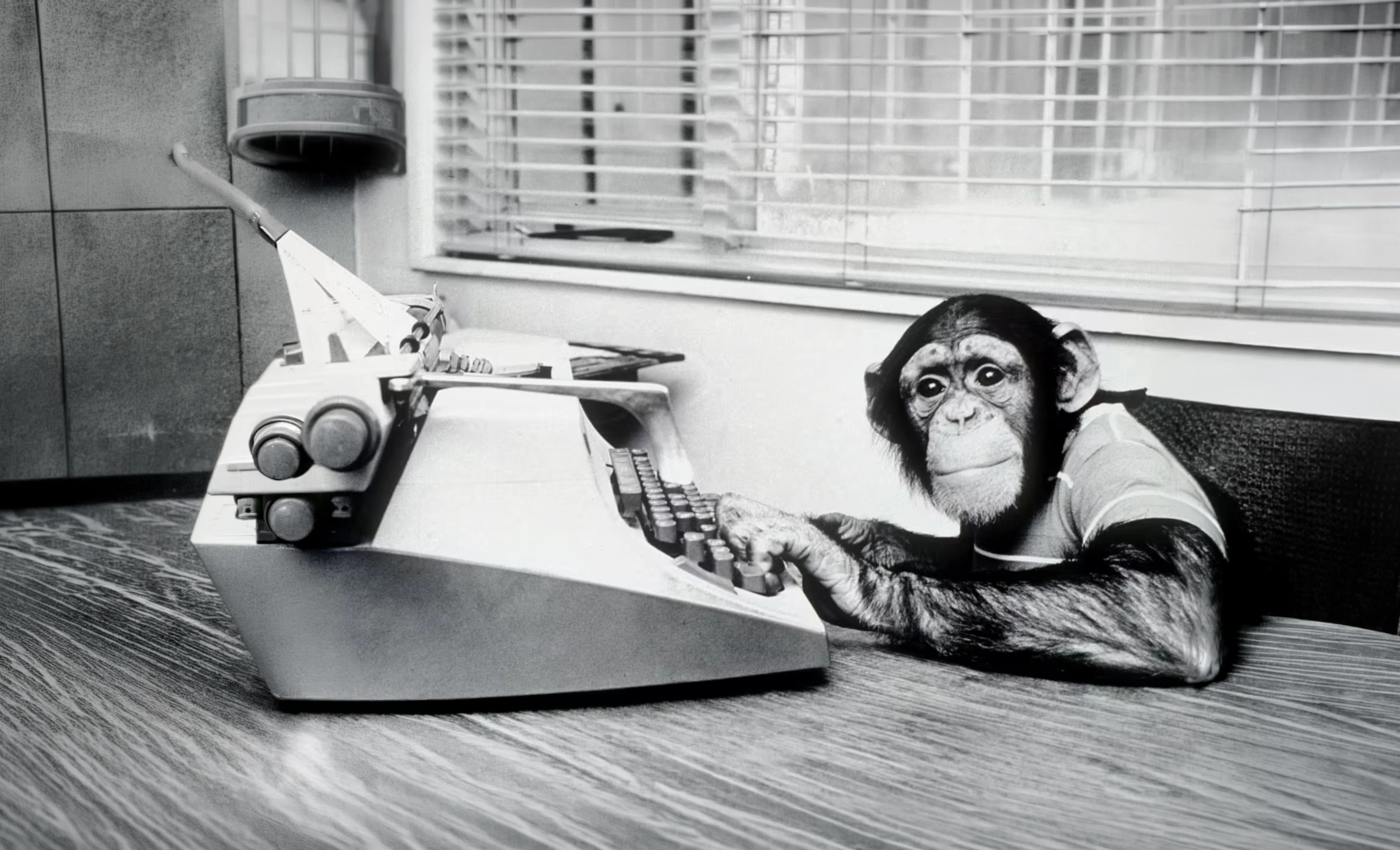
There is a famous saying about monkeys. Give enough monkeys typewriters and enough time, the saying goes, and eventually it will type Shakespeare’s Hamlet, character for character.
Mathematically, this is true. But let’s have some fun. How likely is this, really?
Hamlet is roughly 130,000 letters long. On a simplified keyboard with 26 letters, the probability that a random 130,000-letter string happens to spell the entirety of Hamlet is calculated by multiplying 1/26 by itself 130,000 times, written as (1/26)^130,000. That works out to about one in 10^183,946. A one followed by roughly 184,000 zeros.
Now grant every possible generosity. Imagine that every atom in the observable universe, all 10^80 of them, is a monkey. Each one types ten characters per second, every second, without rest. And we let them keep going not just until the sun dies, not until the last star burns out, but all the way to 10^100 years from now, when the last black holes finish evaporating and the universe enters its long dark era. The period after which there will be no more energy gradients, no more chemistry, no more anything. Across all those monkeys, across all that time, the total number of 130,000-character attempts comes out to about 10^183. The odds that Hamlet appears even once? About one in 10^183,758.
If you tried to write that number out in full at one zero per second it would take two days of continuous writing just to finish writing the zeros. Not the number. The zeros at the end.
A human wrote Hamlet. Chance never would have. Not in this universe. Not in a trillion trillion universes (which would only subtract 24 zeros from the 183,758 zeros). The physical universe runs out of room by a factor so vast that the gap itself cannot really be described.
People say the monkey line all the time. At dinner parties. In op-eds. On stage. They say it with the casual confidence of someone making an obvious point. Eventually, they say. Given enough time, they say. They say it because they have never once stopped to do the math.
We say the same thing about educating people for the coming workforce. The workforce will reskill itself. The market will sort it. We say it at conferences. We say it in policy papers. Tools will arrive, and people will pick them up, and given enough time, something useful will emerge. We’ll leave it to chance. We say it with the same casual confidence as the monkeys-and-Hamlet line, and for the same reason.
Some people will learn. Some always do. I recently met a teenager who skips his classes. But he taught himself to build a safe custom version of OpenClaw and then got a 1580 on the SAT because he built himself a perfect replica of the SAT exam that would learn what he was struggling with and drill him on it until he became an expert at all the problem types. But a few kids stumbling into that is not the same as saying that the entire world will reskill. Markets are good at rewarding the people who cross the gap. They are much less reliable at making sure billions of people cross it in time. Three billion people do not become fluent in a new technological age by accident. We have not really asked what the math requires.
We don’t have the time to wait and hope. Look at the gaps between those who are participating in economic growth and those who aren't. Look at how it is showing up in people's ability to afford housing, or olive oil. Look at how it is showing up in our politics. And the impact of what is coming has not really even begun to land. We have already waited decades to adapt, and we know how it is going. It isn't happening. In today’s exponential world the margin is gone.
The System and The People
How will humanity train the coming generation to hold jobs in a world of AI? The systems and people we have delegated this task to are structurally incapable of doing it. That may sound harsh, but look at the system and the people, both:
The System: An advisor of Endless, Jishnu Das, has a phrase I find profoundly insightful. “The system is not broken. The system is adapted.” What he means is that the systems we have built are adapted to the constraints and incentives they were given. By these measures, they are successful. Education systems were designed to deliver consistent outcomes from Idaho to California, from Manchester to Mumbai. They were built to be resilient to the variable quality of teachers, the changing tides of politics, the variety of geographies, and the rotating generations of leaders passing through. The superintendents of high poverty school districts rotate every three years on average, and the system absorbs each one without changing its shape. The system evolved to be resistant to change. To produce a predictable “Common Core” set of skills. It’s that same system that must now adapt, as radically and as quickly as our world is changing. It won’t. We cannot expect the system to solve this problem.
The People: Then there are the people inside it. Teachers are trained to teach the subjects they themselves were taught. Things like math. Science. History. The grammar of an essay. The structure of a paragraph. All important things. But AI is a different beast. So is design. So is entrepreneurship. These are different worlds, with different vocabularies and different rhythms. The people who have those skills (the engineers, the designers, the founders) are often earning salaries that are multiples of a teacher's. The people who are supposed to teach it don’t know how to and the people who know how to aren’t going to. We cannot expect the people inside the system to solve it.
It is like hoping for Shakespeare. We cannot leave this transition to chance. We must design it. And that begins with finding bedrock: the truths solid enough to build on.
The Foundational Principles
The first act of this book argued that the stakes are civilizational. That a generation of humans is being asked to navigate the largest technological transition in history. That the cost of failure is not measured in inconvenience. It is measured in displaced lives, fractured economies, and a gap between the people who can use these tools and the people who cannot. A gap that, if it widens enough, may never close.
This is the case against the door marked “patience”. Or the door marked “chance”. What is left, when both of those doors are closed, is the door marked “design”.
That is what Act Two is about.
Design begins with bedrock. With principles solid enough to build on. The pillars beneath the curriculum, the platforms, the policies. The chapters of this act name them, one by one.
I did not start with these principles. I found them. We tried things. We stumbled and discovered. We tried again, and discovered more. We had insights while building. We watched others reach the top, and once we saw their path, what they did became obvious. We found inspiration in places education considers blasphemy, and in fast-moving worlds education rarely thinks to look. We ran programs and got splinters. We smoothed them out, and discovered truths in the sanding. We found partners who taught us things we did not know we needed to learn.
I will tell more of that story in Act Three. For now, what I want to give you is what those years produced. These are clues. Hints, half-shapes, pointing somewhere. But once you have them all, they become something else. They become building blocks. Pieces that fit together. And once you know which pieces have to be in the box, the shape of the answer starts to come together quickly. You stop guessing what the solution looks like. You start placing pieces.
I had to find them as clues. You get to use them as blocks.
They are not all-encompassing. A project this large has no sufficient conditions. But they are necessary. They were always present in the work that worked, and always missing in the work that did not. In a world where so much is uncertain, knowing what is necessary is no small thing.
This is the threshold of a civilizational moment. The tools are moving faster than the systems built to teach them. We either find a way to rise up or we are all consumed. Not just the people on the wrong side of the gap. All of us. We do not have enough time to hope.
Remember the monkeys. Chance will not carry us across. Patience will not carry us across.
So we open the only door that is left.
We build.
And we start by putting all the pieces on the floor.