The Endless Mission
Tells the origin story of Endless Studios through The Endless Mission, the ambitious early game that almost worked, and the three lessons (out of money, build-to-learn, community) that became the foundation of everything that followed.
Published July 4, 2026

"A brilliant toolkit for community game creation."
— The Indie Game Website.
The Endless Mission is where my story with gaming began. In the early days of Endless OS, I felt like anything was possible. It felt like destiny. We were going to be in the hands of billions of people everywhere in the world. And those kids would need the ultimate tool to teach them. We needed to be able to teach kids who lived anywhere, beyond the reach of an internet connection and a quality school. How would we do that? Through games.
So many of our engineers learned about coding by hacking their games. And in 2014 this spawned the seeds of an idea. What if the game were meant to be hacked? The idea started to evolve, to merge the notion of hacking with hidden Easter eggs sprinkled throughout our operating system, with a rich narrative where players go on a hero's journey. When I told someone about this idea, they told me that I had to read a little-known book that had just come out, called Ready Player One. That, more than anything, made this game click.
The book was about a giant “Easter Egg hunt”. Easter eggs in games are hidden secrets that game developers left behind for players. They might be a secret room, a secret level, an unlock code that unlocks special powers. For gamers, you'll know how delightful they are to find. For non-gamers, they have the allure of discovering a secret passageway hidden behind a bookcase, and the best ones are those that take a little bit of genius or skill or persistence to find, that I can be proud to have discovered and proud to share that I discovered. Ready Player One is all about a high stakes Easter egg hunt, in which these Easter eggs, hidden in plain sight, are the keys to the kingdom. The future was at stake.
That's exactly the feeling that I wanted to create. What if there were Easter eggs everywhere in our operating system? What if hacking were your superpower? Hacking meant so many things in gameland. Everything from hacking the jump height of a character to access hidden platforms, to hacking enemy robots to be at your beck and call in storming a castle, to hacking the camera's z-axis of a 2D platformer to turn it into a 3D game with side quests, or hacking a drone to be more powerful, or defending servers from oncoming cyberattacks. But the core behind all of it is that software is malleable, and secrets hide within their lines.
The third thing that clicked was inspired by Kickstarter. We had just launched a successful Kickstarter for our endless computers. I was thinking about doing that same thing for this game. The idea was as much about building a community of contributors as it was about fundraising. One day, I visualized a game in which many different developers had contributed their games, each with their own Easter eggs embedded. The visual of an airport emerged. I was traveling hundreds of days a year. Perhaps that was the source. But I visualized a vast terminal full of gates to other universes. Each game was contributed by community members. Each game was part of a trajectory of a deeper narrative.
When I watched Ready Player One, I realized that I wanted to build the Oasis. Having a ready example of how this collection of games can be woven into a cohesive narrative gave me the confidence to knit together our own version. I didn't want to copy the narrative. I had ideas for a much more intriguing narrative, one that would welcome people into the world behind the binary. The Matrix was a far greater inspiration for the narrative that was unfolding in my mind. I would go on long walks, sometimes four and five hour walks, across the hills of San Francisco, brainstorming these ideas. Sometimes on the phone with someone, and sometimes just letting my mind wander with the endorphins of climbing up Twin Peaks to see the golden view of the Bay.
I looked back at the very first document that I wrote about The Endless Mission. It began: "The Endless Mission is the game that every parent wants their child to play. More importantly, it is the game that every child wants to play." Those words are the heart of how I feel about games today. I went on: "Imagine a world where nothing is quite as it seems. The more you learn about it, the more you discover that the world is like the matrix… Everything has layers unseen to the human eye. Everything is manipulable."
I wrote, in that very first document, "It is not an educational video game. It is a game of intelligence and puzzles, where one realizes that their mind is their most powerful tool. The more the player understands its power, the more power they hold."
Seed Meets Earth
Sometimes chance encounters change your life. This one changed mine. Up until this point, these machinations had been just that. Ideas. Floating around in my head for when I would one day have time to build something. Then it happened. I was invited to a chance meeting.
The meeting was with E-Line Media, a game studio that was presenting a pitch for a game about the oceans. The game would go on to become Beyond Blue, one of Apple Arcade's flagship launch titles. After their presentation, I asked them about my idea for this game. "It's a game where there are lots of games, and everything is hackable, and there's a meta-narrative that grapples with the heart of technology." They probably thought I was crazy. They were probably a little bit right.
A few weeks later, I happened to be flying to TED on a flight with E-Line’s co-founder, Alan Gershenfeld. I learned more about their history. Alan had run Activision Studios, starting with the company when it was about 12 people and running the studios until it was a few thousand. Alan was as enamored with global cultures as I was, having built the beginnings of a global culture game series, starting with the highly acclaimed Never Alone video game, which has won a Peabody Award and was featured on every iPad and iPhone in every Apple Store in the world. More importantly, they understood the intersection of games and learning better than anyone. They built and ran Minecraft.edu and Gamestar Mechanic, a game about game design that was used to build millions of games. They ran the White House National STEM Video Game Challenge, the winner of which got to present to Obama.
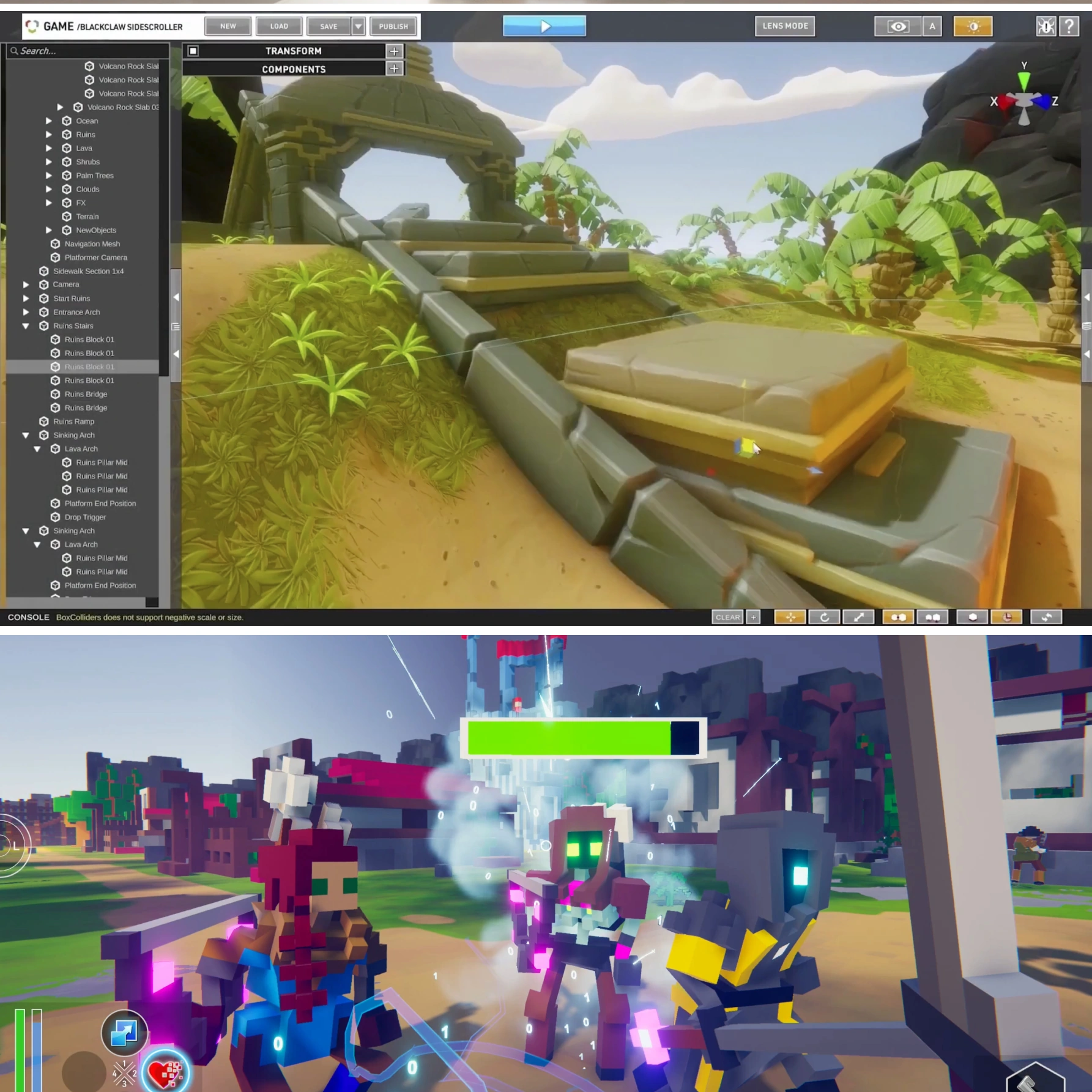
On this flight, I also got the chance to explain this wild idea in more detail. We decided to set up a meeting with their team. That led to a very small working project to explore the idea further. The more the team started to wrap their heads around the idea, the more it started to take form. Yes, we would focus on a narrative questline, but we would also focus on game creation, like a more advanced version of their Gamestar Mechanic, and we would build a sandbox game, where you could build any sort of game you wanted, and then we would embed an adventure game within the games that emerged.
I sat down with our industrial designer and built a physical Terminal, like an airport, a beautiful blank canvas of heavenly glowing white, with the idea that it would receive all of the floral embellishments of your creativity as you play through the game. We built some hard infrastructure, with the capability of changing the underlying code that powers the game in real time, a technical feat that blows away any engineer who knows how hard that is to do. We even had Unity's engineers applauding us. And then we began designing the quests. We built out a small handful of “gate games”, including a real-time strategy game, a racing game, and a platformer. We built the Shadow Terminal, deep in the bowels of the Terminal, a place where players would go to see what happens when all of the wires of these games up above crossed in wild ways. As we saw our budget dwindling, we knew we had to launch. We decided to launch an early access title on Steam. Basically, that was our way of acknowledging that the game wasn't production ready, but that we were hoping that our sales would generate enough traction for us to continue development.
Today, there are tons of projects on the market like it. Manticore, the Sandbox, Crayta. The idea of the metaverse has evolved into something so overblown it shocks me. But at the time there was nothing like it on the market. The idea seemed totally crazy. I didn't know if anyone would get what we were going for. But the reviews got what we were trying to do. And almost everyone loved it.
Variety: "The extremely unique game, announced last week, not only blends together genres, it literally puts the tools of game creation on the player's screen."
PC Gamer: "I wish I had something like this to tinker around in as a kid."
PC Power Play: "The Endless Mission is looking bonkers in the best possible way."
WCCFTech: "The Endless Mission is a game that doesn't really have a genre… it's a teaching tool… The developers have purposefully created the game so many of the menus and ways players can interact with the game resemble the options you would use in the Unity engine editor. Essentially, after playing around in The Endless Mission for hours, you should have a very basic understanding of how Unity works."
GamesRadar: "When I was young, I pictured game developers building a world, changing a number or two in the code, and then hopping immediately back into the game to play around with their changes. Swapping out an overalls-wearing plumber for a blue hedgehog was, in my mind, just that easy. Of course, we know better now. The biggest games are made by teams of hundreds, each working on their own little piece of the puzzle… The Endless Mission has the potential to turn those dreams into reality, to empower the everyday person to create. I hope it succeeds."
The day that these reviews came out, I was so moved that I nearly cried. They got it.
Three Lessons
In the wake of the launch, we also learned three lessons. Everything that Endless Studios does today spawned from those three lessons.
First, we ran out of money. This was a $100 million project. There was so much to build, we would never be able to build it ourselves, on our budget.
Second, you learn more by building games than by playing them. As WCCFTech said, "creating is infinitely more interesting." That married beautifully with the idea that, if the community liked what we were doing, the community could build it with us.
The third insight was born from the first and second insights. If the community was going to be the heart of everything that we were doing, and if you can learn more by building than by playing, we needed to build a learning environment for the community. The community needed a home, tools and mentorship, if we were going to fulfill the promise of being the best place for someone to learn real skills by building games with us.
We took a step back and rethought our strategy. It wasn't just about tweaking our game. It was about rethinking everything from the ground up, asking ourselves what it means to build a global youth game making studio. And Endless Studios was born.