From Play to Pay: Games Built By The Community
Lays out the bounty model: a way to fund and build games at lower cost and higher quality by breaking them into atomic tasks and letting a community of learners contribute, the way open source built Linux.
Published July 4, 2026
“Open source is not about saving money, it’s about doing more with less—and creating something no single company ever could.”
— Jim Whitehurst
Great games are expensive to build, and countless promising ideas never get made because the budgets required are out of reach. But what if game development didn’t have to rely on massive up-front funding and closed studios? By breaking games into modular, well-defined tasks, and inviting a global community of learners and creators to contribute, it’s possible to lower costs, increase quality, and build a fanbase before the game even ships. Inspired by the methodology behind open source software, this model transforms development into a collaborative, distributed process, where contributors gain real experience, studios harness a swarm of creativity, and the boundary between player and developer begins to dissolve. The result isn’t just more affordable games, but better ones: games with built-in communities, richer perspectives, and a marketing engine that begins the moment the game idea is released.
"That bush is $1,000, that tree is $3,000,” a veteran game developer once told me about a AAA title. Every tiny decorative element, from the moss on a rock to the rust on a fence, represents hours of labor and thousands of dollars. It's a surreal reminder: games aren't just creative expressions, they're economic beasts. And they are expensive. That is how the budget for games like Hogwarts Legacy tally up to $150 million and GTA 6 burns a billion dollars. Every detail costs something. Every task adds up.
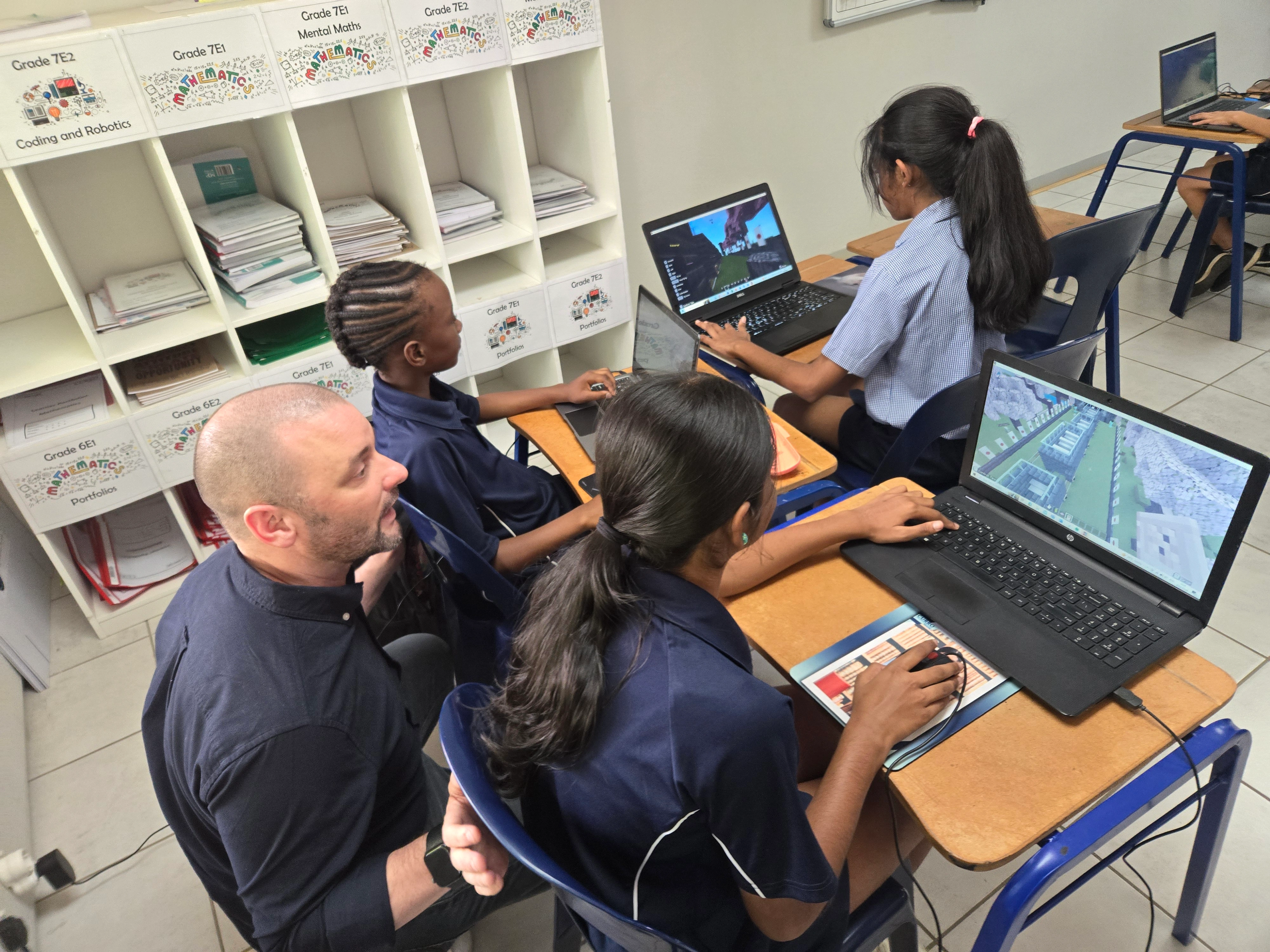
That's not just a AAA problem. Indie developers wrestle with this too. I've lived it. We poured millions into The Endless Mission, an ambitious game to teach kids to code through a beautiful, immersive world. But despite partnering with the creators of Minecraft.edu, we ran out of money before it was done.
On the flip side, we had another team build smaller games with studios in emerging markets, building leaner, faster, with tiny budgets. Some even made it to the top of Hour of Code. But none reached the polish needed for open market success.
We were stuck in the gap. Our "big" game needed millions more. Our "small" games weren't good enough. It was like standing between two cliffs with no bridge in sight.
The problem isn’t unique to us. I was recently talking to Sir Ian Livingstone, whose books have sold over 20 million copies. His most successful book, Deathtrap Dungeon, was turned into a video game in the late 1990s. I asked if he would want to build another game on the game’s IP. His answer was: of course I would want that. Why hasn't he? It's too hard to get the budget. He keeps writing his books because he has a diehard fan base. But it takes many millions to build such a game, and who knows whether there would be an appetite for such a game.
There are countless such games that go unbuilt. The old fan favorites that never get rebooted, books with cult followings, successful emerging markets IP like Black Myth Wukong’s that couldn’t marshal resources, student games that have so much promise but no chance of getting funded, the board games that could be turned into video games, the influencers with creativity and a community but no money. The educational games, the impact games, the studios that ran out of money, the sequels unmade. All the potential.
Kickstarter has been a boon for such ideas. If the VCs won’t fund you, go straight to your fans. When you search Kickstarter for games you get 100,000 projects, but nearly all of them are board games, because video games cost too much money to make for all but the most scrappy of teams or the most successful of Kickstarter projects. The problem is that video games require sprawling teams of designers, artists, and engineers. Development cycles are long, budgets steep and risks high. Video games rarely do at the scale that they are needed. Even the most exciting ideas often never make it past the concept stage. The bar for investment is too high. The result: a graveyard of great ideas. Games that fans would have loved, but no one can build.
In our case, we had a realization: If we started turning players into builders, we realized that we could harness their creativity to build the games we wanted to build. If we could do this for our games, then bigger and better studios could do it for theirs. What if we broke big games into atomic units – small, achievable tasks – and let students take them on as part of their learning?
This is how open source projects work, with swarms of contributions managed by a strong team sitting at the center of the project. Anyone can contribute. A management team holds the vision. This disrupted the economics of building software. What if the model could do that for games?
When most people hear “open source,” they think of copyright licenses. But the real magic isn’t legal. It’s procedural. It’s the way open source projects are built: through modular tasks, global contributors, and strong vision at the center. That’s the model we’re adapting for games.
You can keep the code proprietary. But what would it look like to lean into the processes that power open source? Let’s double-click into what that actually looks like, and why it’s powerful.
The Long List of Tasks
Here's the crucial insight: software development is fundamentally atomic. Every game can be broken down into discrete, individual tasks. Recently, our engineering lead broke down just one feature (branching dialogue) into its component pieces:
New inspector types (half a week).
Level library implementation (1.5 weeks).
Export functionality (half a week).
Player states (half a week).
And a dozen other tasks
Each piece traditionally comes with a price tag, quoted in "man months" at professional salaries. This task-based structure exists in all software development, and it's exactly what makes a new economic model possible.
The bounty model reimagines how we pay for these atomic tasks. Instead of hiring full-time professionals at market rates, we can create individual bounties for specific, well-defined tasks.
Here's the economic transformation: Instead of a full-time 3D artist at $120,000 annually, imagine listing everything that you need and posting bounties: $50 for environmental assets. $200 for character animations. $100 for sound effects. $500 for level layouts
A $50,000 bounty budget could yield hundreds of game assets, work that might cost 5-10x more through traditional development. Contributors are there to learn, so they accept lower rates in exchange for skill development. More advanced contributors in lower-cost regions can earn meaningful income at rates still below Western market rates.
The Idea In Action
This model is already proven at scale in many places.
Starting with the gig economy, Upwork processes over $1 billion in freelance work annually. Fiverr, which started with the simple concept of $5 micro-tasks, now facilitates over $1 billion in annual transactions across 550 different service categories. 99designs has paid out over $300 million to designers for individual design contributions.
Open source software is built in this same way. A project can have thousands of contributors, each contributing individual tasks to a common codebase. Linux, with its 30 million lines of code contributed by over 15,000 developers, exemplifies this power. Individual contributors might work on small pieces, like optimizing a device driver or fixing a security bug, but together people all around the world have built one of the world's most important software projects.
On a smaller scale, when developing our Godot block coding plugin, our team didn't have time to extend it from 2D to 3D. Instead of hiring more developers, we broke down the requirements into bounties and posted them to our community. The tasks were completed for $1,000. One contributor got so excited about the project that he started improving the tool beyond the goal.
During my internship at Infosys, I saw firsthand how the Indian business process outsourcing (BPO) market worked. Infosys has highly skilled architects break engineering projects into simple units of contribution, and then hire smart, motivated people and train them from scratch. Within months, these trainees are helping build software for Fortune 500 companies.
Epic Games recently demonstrated the power of the approach with Project Titan. This collaborative art jam invited artists and developers around the world to contribute to a massive open-world environment, resulting in a 64-square-kilometer landscape featuring nine distinct biomes filled with imaginative characters and assets.
Frankly, the process is the same in AAA game studios. Even the biggest titles, like GTA and Hogwarts Legacy, are made by hundreds of people, each working on modular tasks.
We see this in Wikipedia, where millions of contributors have contributed over 4.5 billion words to almost 7 million articles, with a strong team of community editors sitting at the center. Compare this to the now defunct Encyclopedia Britannica, which had 44 million words (1% of Wikipedia) in 120,000 articles. Why haven’t we built games with this model?
We even see this in the physical realm with Habitat for Humanity. To build a house, you need an architect with a plan. Then you need a swarm of people to set the foundation, put up the frame, clad the siding, put in the plumbing and electricals, put up the drywall, and lay a roof. Habitat takes groups of people who have never built a house and teaches them to build, task by task.
Development is Marketing
Game development doesn’t happen in a vacuum. Today, success is as much about distribution and community as it is about the game itself. With over 14,000 games launched on Steam every year – more than 250 each week – even brilliant titles often vanish in the flood. One of the most reliable predictors of a game’s commercial success isn’t polish or gameplay, but the number of players who wishlist the game on Steam before it ever launches. In other words, your ability to build momentum before release often determines whether your game will rise or be forgotten.
That’s why many studios now hire community managers early in development, long before launch. They post dev blogs, tease features, share concept art, and create a sense of narrative around the game's creation. But what if the community didn’t just follow the process. What if they were part of it? Contributors could playtest mechanics and submit feedback. Others might share story ideas, create art, or design levels. The most engaged contributors might unlock early access builds, join private Discord channels, or even be invited to on-site feedback sessions. In this model, marketing and development become one and the same. Your community doesn't just root for your success. They’re part of it. The line between the studio and the fanbase begins to blur. And in that blur, something powerful emerges: a game with a built-in audience, a team larger than your payroll, and a world shaped by the people who want to live in it. And who shape it to be something that they want to live in.
The AI-Enabled “GPU” For Game Making
This kind of development process reminds me of the difference between a GPU and a CPU. You need a CPU to coordinate and organize everything, in the same way as you need a central team to coordinate and organize contributors. But when it comes to doing massive complex calculations simultaneously, the GPU's parallel processing power is essential. This sort of task-based system serves the equivalent function of a GPU. You can upload requests for a thousand tasks and harness the sheer volume of swarms descending like processing power.
Modern tools and AI dramatically enhance the effectiveness of this model. Tasks that once required deep expertise can now be achieved by motivated beginners. A texture that might have taken an expert artist hours can be created in minutes using Midjourney. A $5 bounty today can produce work of higher quality than what would have cost hundreds of dollars in the pre-AI era.
This collectively means smaller studios can now achieve quality that was previously limited to far larger studios. An indie team using the community bounty model plus AI tools can create assets that look nearly as good as those from teams with 100x their budget.
Think of it like Habitat for Humanity's approach to homebuilding, taking complex construction projects and breaking them into learnable tasks that volunteers can accomplish under expert guidance. The bounty model creates a similar virtuous cycle:
- Learners get real-world experience
- Studios get cost-effective development
- Games get richer content through diverse contributions
- Better games bring in more players as potential creators
Now let’s explore what this means for the real world of game studios.
The Future of the Game Industry?
The data on game development economics tells a clear story. Looking at Steam's marketplace, 69% of games are indie games with budgets of $10,000 - $500,000. This 69% of shipped titles generates only 9% of revenue. Meanwhile, AA indie games, which aim for polished experiences without the massive costs of AAA, account for 3% of titles. But they capture 66% of revenue. The revenue disparity is staggering. Clearly, you want to chase that 66% of revenue.
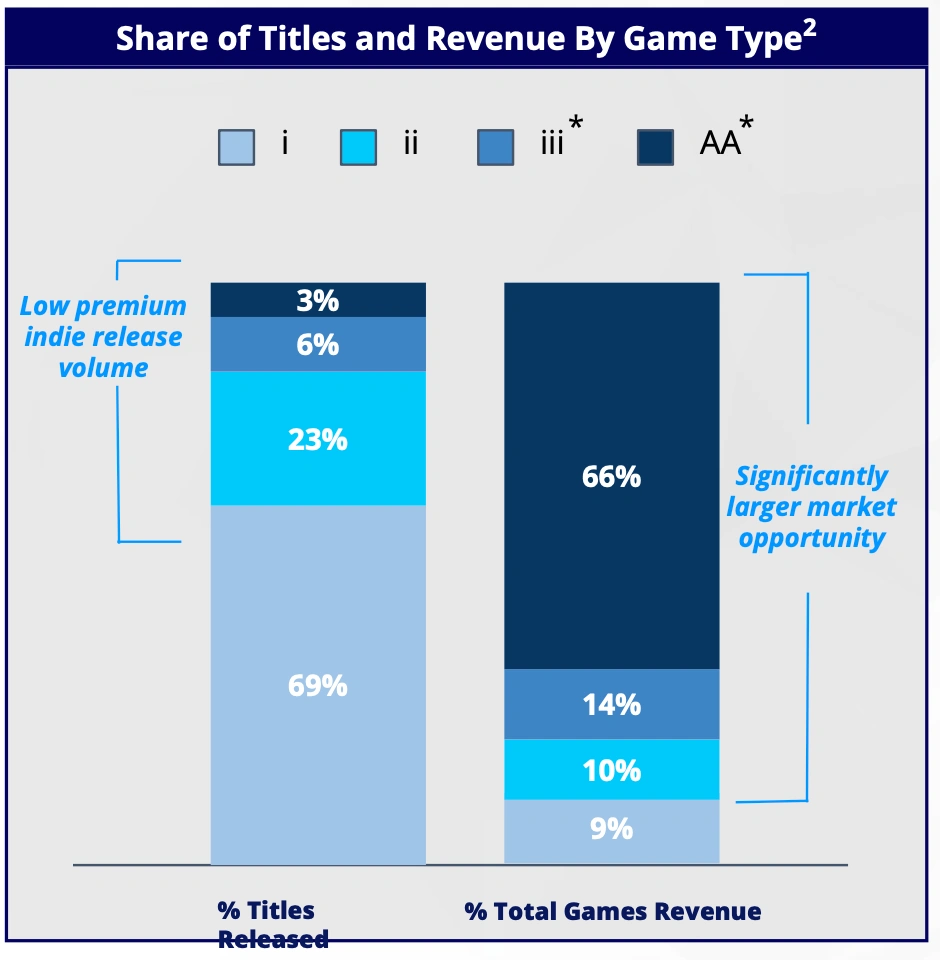
The problem is getting the money to build those games. AA games cost a lot more money (often double digit millions of dollars). It's hard to raise that much money. Those who do are able to take more creative risks than AAA games, and that’s often rewarded handsomely. Take Palworld, which cost $7 million and made half a billion dollars in revenue. But most studios can’t raise the money. They can’t build these more ambitious games, so they build the cheap games that they can afford, and thrash around in the turbulent waters at the bottom of the barrel. And that’s for the lucky few that are able to get any funding at all. It’s a tough industry.
What if you could enable small budget studios to punch above their weight class? What if you could make iii and AA games on i and ii budgets? You could chase the big slice of the pie.
Our foundation team is in the midst of building a highly ambitious game. They have $30,000. They are getting professional art for $250 per character, while college students learn by contributing game mechanics and high school students learn while building hundreds of levels. A small team has built a massive game by opening up its creative systems to the community, breaking down tasks, making them accessible, and training contributors to join them in building.
Now imagine being a small game studio working with students in emerging markets, paying $10 per task, twice Fiverr’s original $5 model. For the students, that’s meaningful income. For the studio, that means a thousand tasks would cost just $10,000.
And that’s what it looks like with small budgets. The real magic happens when this model is combined with professional leadership and larger funding, when you have the vision of a studio, the structure of a production pipeline, and the scale of a community. That’s when you stop just saving money and start unlocking something fundamentally new. The cooler the game, the more people want to be part of it. That’s the magic of this model. It’s like modding, but instead of working on side projects or spinoffs, you're contributing directly to the real game itself.
I was recently talking to the former head of Humble Games, and he told me about a project where a game studio they invested in ran out of budget. Instead of shelving the game, they opened it to their community. Players and fans built the levels they couldn’t afford to make in-house. The studio curated and polished the best of them. That game, which almost never shipped, became a breakout hit, because the community was the development team.
In another conversation with a leading game studio, they responded to my description of this idea eagerly, telling me that when they had to shut down the development of the sequel to one of their games, a few members of their community asked if they could help build it. The studio gave them all of the assets and these community members were so high quality that the studio eventually hired them to run the entire development process and they shipped the game.
One of the studios we're working with is doing exactly this on a game they can't fully finish with their existing budget. They want more levels than they can afford to build in-house. So they’re inviting college game design students to contribute. These students are given the actual level-building tools, the core game mechanics, and a library of art assets, and they’re building the levels. It’s hands-on learning, real-world contribution, and a way to turn what would have been a limited game into something far more expansive.
We’re doing this with our Endstar game engine. There are so many features we dream of adding. Game systems to refine, tools to improve, art to upgrade. Our internal team could never build it all alone. So we’re opening it up. We’re inviting the community in. Students, hobbyists, and professionals alike can contribute not only the things we don’t have time to do, but also things we never would have thought of. That’s the power of creative swarms.
These are each multi-million dollar games, being shaped not just by professionals behind closed doors, but by a global network of contributors. The lines between studio and community are disappearing. The community is the studio, working shoulder-to-shoulder with the pros, not just as testers or fans, but as builders. That’s the future.
A World of Creativity
This isn't just about cost savings. It's about unlocking creativity at scale. Look at the 152 levels in the official Super Mario Bros. Wonder game. Compare that to Super Mario Maker 2, where fans have created over 26 million levels. Or Roblox, which gets more play hours than the entire console market thanks to 40 million community-created games. Who do you think will come up with better ideas: a team of half a dozen level designers, or a swarm of hundreds or perhaps even millions of passionate players-turned-creators? The community will almost always generate more innovation than any small professional team could imagine.
The Ubuntu project has a saying: "If you want to go fast, go alone. If you want to go far, go together." If we let our communities join us in the game development process, we can go far indeed, making game development more accessible, educational, and economically viable all at once. We create a system where learning and creation reinforce each other, where students can get paid, where studios can thrive and where we can all build better games.