The Time Machine
Through an 1860s schoolbook and a grieving mother's Bible, establishes books as time travel and asks what we should carry forward from older eras as we build a new one.
Published January 1, 2026
“What an astonishing thing a book is… One glance at it and you’re inside the mind of another person, maybe somebody dead for thousands of years. Across the millennia, an author is speaking clearly and silently inside your head, directly to you… Books break the shackles of time. A book is proof that humans are capable of working magic.”
— Carl Sagan
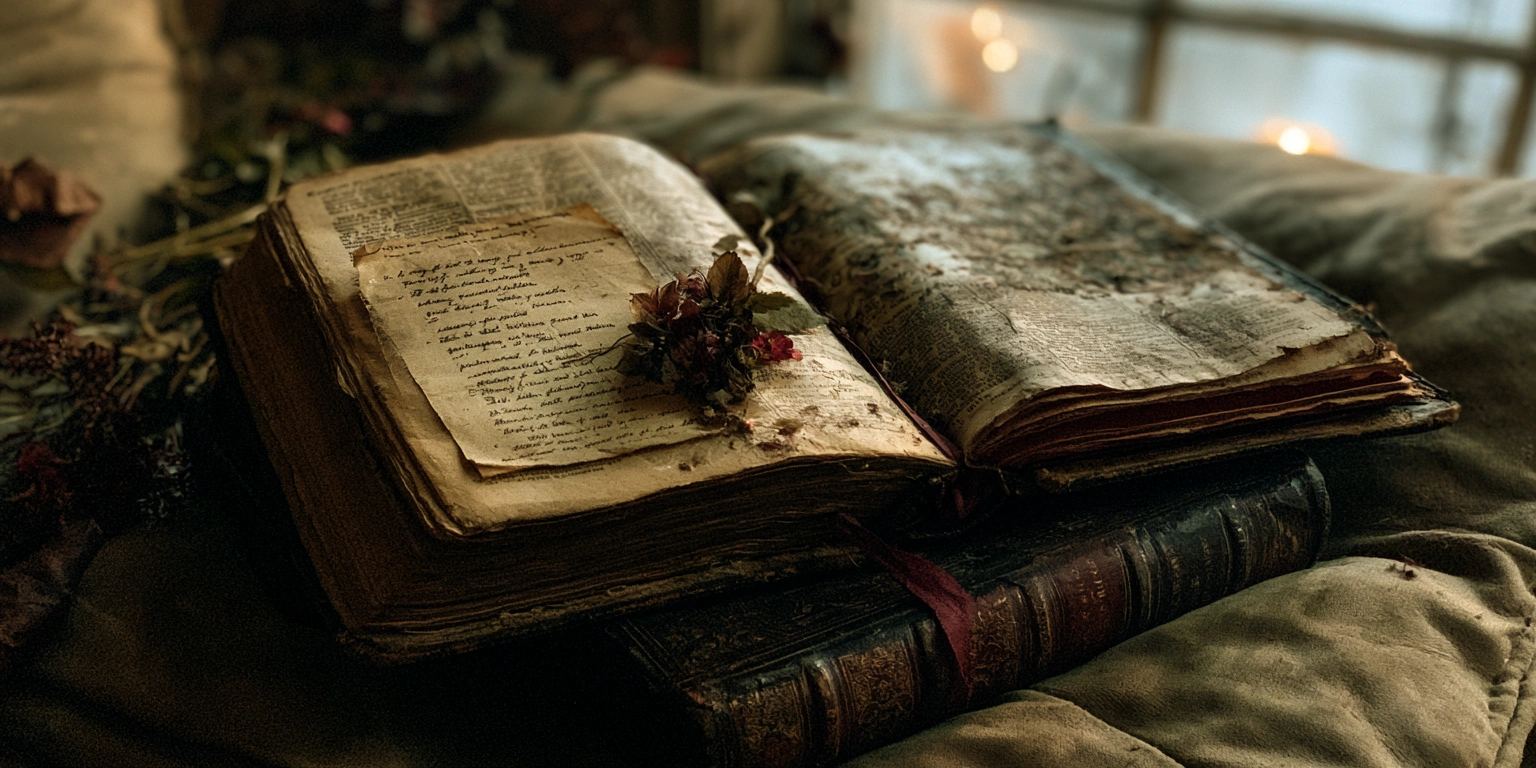
I'm not sure where it came from. I had never seen it before, this aged Bible that I pulled up from a box of packed books. It was ancient, like a manuscript from Gutenberg’s day with an inscription from June 25, 1881, written in perfect script. I opened its fragile cover with the same care I used to hold my newborn son. There on the inside cover, I found a tiny clipping:
To Mary Ellen Moore, In Heaven,
Who died August 1st, 1856, aged 1 year
I was transported. It was followed by the words of a poem that took up inches. Small, like her. But they filled the room. In these few words, I could feel the heartbreak of a lifetime.
Sweet innocent, thy gentle life,
Was but a summer's day;
A few short, transitory hours,
And thou hast passed away.
Thou wert a tender little bud –
A mother’s darling child –
And by thy tender joyousness
Were all her hours beguiled.
God saw the flower so beautiful,
And plucked the precious gem,
And placed it in his coronet,
To grace his diadem.
I could feel a mother's ache tucked away in her Bible where only God and her could find it. It was like witnessing a life lived and taken, like Pompeii’s ashes, frozen in time, a grief that has been alive, waiting for me, for 170 years. This child, forever being plucked. I touch the little adhesive circle that her mother must have touched with her finger as she pasted in her daughter’s poem.
Sacred, like a little relic.
For most of my life, I longed for simpler eras, when life felt slower, and lives seemed far purer. But life was hard. That duality is stitched into the bookmark I found in this Bible at Psalms XXIII, the word “Virtue” delicately crocheted upon it. “Yea, though I walk through the valley of the shadow of death, I will fear no evil: for thou art with me.” The bookmark remains there forever, a permanent reminder of the shadow of death.
Today, reading this, I choose to live in modernity. In a world in which my wife can give birth safely and my children’s common cold is nothing to fear. Today, I simply want to carry forward all that is still worth carrying from those who came before us.
I opened another page and found a pressed flower. Untouched for more than a century, I imagine it was placed there by her mother. It must have been a beautiful, bright, colorful thing. Its petals are still clear. If I look closely enough, I can almost see it return to its full dimensions. Its lines are like a contour map whose two dimensional curves reveal the depth of the terrain. Her mother saw a flower so beautiful, plucked the precious gem and placed it here, for eternity.
I feel reverence whenever I hold an antique book. I'm holding something that has lived through lifetimes. Somehow it feels almost Holy. As if I am holding life itself in my hands. Generations of people held this long before my great-grandparents had been born. Each person stewarded it so that I could finally witness it today. Touching this Bible feels like transporting my soul long into centuries past. When I close my eyes, this mother’s hands feel like shadows upon mine. Time is the only distance between us holding hands. Consoling the hands that held this little girl.
It feels like time is bound up behind me, wound up ahead of me, and splayed open today.
Books are like time travel. This mother, hundreds of years ago, comforted by words written thousands of years ago, with all of us sitting here in my living room. Books are a reminder, as Carl Sagan put it, that, “we are like butterflies who flutter for a day and think it is forever.”
As Elif Shafak put it, these “ghosts are excellent teachers, and they are very patient.”
One day, someone I love may feel my heart in these words when my life has fluttered by.
These books remind me of insights that are like distant stars on an evening full of wispy clouds. Their truths are blazing hot, vibrant with all fury, beaming light into the world, but because we so rarely take the time to pause and look up and ponder them, we forget that they shine so brightly. Reading these ancient pages felt like a tether between me here, anchored on Earth, and that beautiful orb of fire in the heavens. They contained truths that were like waypoints for my soul. We live a modern life, far from the guidance of such light. But we must make a pilgrimage into the past to uncover wisdom that has been shrouded by the fog of distance and time. It was with this mindset that I continued exploring the box of books before me.
The Reader
Within that same box of books I found another book from 1860: The Fourth Reader Of The School And Family. The cover is an old, sepia-tinted print with illustrated lithography looking like embroidery, a pair of birds and the word “READER” capitalized across the front. The lettering of its name has faded like an ancient memory. Holding it feels like I have reached into one of those weathered 1800s black and white photographs of people who are captured as ghosts, taken this time-burnt thing from their hands and placed it here onto the cream woven throw on my soft alabaster couch. It is as if I invited someone from that photograph to sit on my couch. They are still living in black and white. I can touch this person. I can talk to them, and read into their mind.
Words are the closest thing we have to time travel. An old book is the closest thing that we have to a time machine. Sagan, again, said, “to read is to voyage through time.” Reading this Reader, I felt like H.G. Wells' time traveler did in The Time Machine. Like going from Homer to Asimov, the time traveler goes far back in time and then into the distant future, peering beyond the edges of civilization. "As I drove on, a peculiar change crept over the appearance of things. The palpitating grayness grew darker; then - though I was still traveling with prodigious velocity - the blinking succession of day and night, which was usually indicative of a slower pace, returned, and grew more and more marked. The alternations of night and day grew slower and slower, and so did the passage of the sun across the sky, until they seem to stretch through centuries."
Like him, opening this Reader I felt like I had shown up in a foreign land, trying to make sense of its ways. "I was like a savage who has come upon a modern town for the first time, who stands bewildered before its machines and mysteries, trying to reconcile what he sees with the narrow experience of his simple life. Except that I was the savage from the past, and these were the inheritors of all the ages." So it was that I was transported to the land of yore.
I turned to our modern magic – Google – to understand what readers were. They were the primary textbooks of the 19th century. A competing Reader of the time sold 120 million copies, making it one of the most printed books in human history. These were clearly a big deal in their time. This particular Reader was printed right around the time that little Mary Ellen would have needed it. Perhaps her older siblings read this book in their schools. So it was that I traveled my way into her world, stumbling my way into a 19th century classroom.
The very first topic, class, was elocution: “the skill of clear and expressive speech.” That made me wonder: why teach this? And then I realized: how we speak changes how people listen. The art of articulation is perhaps one of the most universally important skills in life. How we speak reflects how we think. By teaching it, we are also refining minds and shaping character. I envision 19th-century classrooms sending articulate, wise little children out into the world. What happens when we stop teaching it? I can’t help but wish we still taught this obscure subject, one that also happens to be the very thing that makes us human: the ability to communicate.
I have gone back to this book many times. It contains so many insights, both the ones that the author intended and the ones that could never have been imagined by someone in the 1860s. The Reader traversed into birds of prey and natural philosophy, botany, the musculature of the human body, followed by prose and poetry. It was like a little dose of curiosity on almost every page I opened. Even physiology bordered on poetic: “The materials of which a muscle is composed are constantly passing away, like water under the influence of the noonday sun, and if no exercise be given to the muscle it soon becomes thin and flabby…. The effect of vigorous exercise of one set of muscles is seen in the arms of the blacksmith, which not only increase in size but become firm and hard.” As I learned about the science of muscles being stretched and strengthened to make ourselves fit and whole, I felt compelled to run. Literally to run. I put down my textbook and ran. When else in my life has a textbook so moved me that I went running?
There was something going on in these 19th-century classrooms that bordered on magic. Certainly, as I ran beneath a golden sunset that day, that’s what I felt. Inspiration and Magic. They call it a “Reader” for a reason. Because you want to read it, the way an interesting book is meant to be read. With intrigue. Such time inside of the classroom should be available to all. Curiosity that becomes inspiration. That is the magic of learning. Wanting to know what’s within.
I’ve often heard the critique that today's educational system, “is a 19th-century education.” It’s true. Our system hasn’t evolved to meet the needs of modernity. But I liked this 19th-century classroom. Through the pages of this Reader, I kept stepping into something deeply human. Every time, I found another insight for my life.
In my 19th-century tours I felt like the Time Traveler did. What if we are the savages, staring blankly at the blinking machines of our own making? We think of ourselves as advanced, but what have we lost? In our sprint toward efficiency, have we become barbarians of the digital age, abandoning slowness, virtue, and a reverence for learning? The claim that our education system hasn’t changed is an injustice to those classrooms. I claim the contrary. It has changed.
Yes, the rows of students remain, but its dignity has degraded. Where are the virtues? Where is the curiosity? Where are the cohorts of little articulate children emerging from our classrooms? Mark Twain and Teddy Roosevelt received this education and helped build a nation with it. Teachers today face rows of students who don’t want to be there. We have a lot to learn from what these early educators did right. As we design the future of education, perhaps we should take a little more inspiration from 19th-century classrooms. We need more humanity in our humanities. More art in our sciences. And to fuel a little more fire from the ideas we consume.
One of the great distinctions between the centuries prior and today is this: there were few writers then, and many readers. Publishing was scarce. Voices were precious. Today, everyone has a platform. Publishing is free. Creation is abundant. The line between educator and learner, creator and consumer, has begun to blur. As we prepare youth for the future workforce, tomorrow, we will all be writers of our own future. We will all be designing products, telling stories, launching ideas, and shaping communities. The skills that matter most will be creative, digital, and entrepreneurial. We’ll need to teach youth to think like designers, to collaborate like coders, and to communicate like storytellers. We’ll need the confidence to prototype, pitch, publish, and pivot. In a world driven by technology, fluency with creation, not just consumption, will define who thrives.
So yes, wisdom prevailed yesterday. Creation prevails today. We need to ensure a future in which youth have both. Which begs the question: if we could distill the best of our ancestors and fuse it with today’s hypercharged needs and technologies, what would the modern Reader look like?
Our Time Together
I want to answer that question in the coming pages, but I want to go back before we go forward. To start at the very beginning of The Book itself and then, from there, to trace how that got us to where we are today. There is an insight to be gleaned within that story which may be history-shaping if we can truly absorb its enormity. From there, we pause in the present. This chapter in human history may be its most important. We’re making decisions, as herds and individuals, that will shape eternity. Let’s be deliberate. Then we can look ahead. What can be done to ensure that our coming chapters are bright? That, ultimately, is the core question. What’s the point of pontificating if it doesn’t lead to change? This is about turning insight into action. What can we do?
The challenge is that we often feel like fleas riding on the back of a stallion we can’t steer. But I write because history can be shaped. It has always been shaped by humans. And it still can be, but only if we are clear about what must be done.
So let’s jam the gears of this time machine, backward, and then forward, and then dare to imagine what’s possible and believe that we can do something to make it so. Come, fellow traveler. Let’s understand, and then make, history.
![image][https://aporqokowvrdgmhmaurv.supabase.co/storage/v1/object/public/chapter-covers/content/mag-01-01-01.webp]