What Is Infinitely Scalable?
Surveys what has scaled in the digital era (MOOCs, games, social media, GitHub) and asks what it would look like to combine the scale of education platforms, the engagement of games, and the production power of creation communities.
Published June 25, 2026
PRINCIPLE: Learning Systems Must Improve With Scale
Here's the thing: we're not the first dreamers to tackle a seemingly insurmountable challenge. So, let's ask ourselves: what can we learn from the trailblazers who've already cracked the code on infinite scalability? What nuggets of wisdom can we mine from their triumphs and stumbles?
From the vast libraries of Wikipedia to the personalized algorithms of Netflix, from the user-generated content of YouTube to the gamified learning of Duolingo - there are institutions of inspiration across the digital landscape. Let’s learn from these ideas, refine them, and forge them into an experience that's not just accessible to all, but irresistibly engaging. Let's roll up our sleeves and dive into the successes and failures of those who've gone before us. In their stories, we might just find the key to unlocking education for every eager mind on this planet.
Education Providers
Let's start by looking at the most directly applicable category: traditional online courseware. As of 2023, Coursera got 142 million registered learners. That's not just a number - that's more people than the entire population of Japan. YouTube: this video behemoth has become an accidental educational powerhouse. YouTube serves 5 billion views every single day, and Pew found that 51 percent of YouTube users use YouTube videos to learn new things. Khan Academy has served over 2 billion lessons since their inception. If each lesson were a person, that'd be almost a third of the world's population. Udemy has over 62 million learners and more than 830 million course enrollments. That's like every person in the UK deciding to take 12 online courses. These numbers aren't just impressive - they're staggering. They're a testament to the global hunger for knowledge and the power of technology to satisfy it.
But here's the million-dollar question: if they are so powerful then why aren’t they the solution? Simple: Engagement. These Massive Open Online Courses, or MOOCs, churn nearly 90 to 95% of the people who start their courses. Video courses simply aren't engaging enough.
The NY Public Library has 10 million books. Access to the information is not sufficient. It’s certainly necessary, but most of those books sit on shelves untouched. 2.3 million visitors walk through the library system each year. How many of them leave with an education? The same is true of these online course providers. We're giving people access to knowledge, but they need the tools and motivation to truly absorb and apply it.
Games and Social Networks
So let’s look at those who are really good at engaging. At the other end of the spectrum, we have games and social media. The average youth will spend 10,000 hours playing games. There are more than 3 billion gamers in the world today. The top ten games get a cumulative 19.2 million years of gameplay every year! Most educators and parents complain that games are too engaging, to the point of addiction. And that’s the point! Most of those games don’t teach very much. So games have engagement, but most fail to be educational. Most of that virtuosity is directed at learning to jump and shoot well, rather than building productive employable skills.
Imagine if we could take these principles - the instant feedback, the sense of progress, the social elements, the sheer fun - and apply them to learning real-world skills. We're not talking about slapping some math problems onto a game of Fortnite. We're talking about reimagining education itself as an engaging, immersive experience that rivals the best games out there. That's the golden ticket - the perfect blend of engagement and education.
Social Media is another massively addictive tool. The dopamine hit of seeing people’s incredible creations, of getting to know the authentic person behind their creations, of getting to put forth your own creations, and getting recognized for them with every dopamine-inducing like and view, and making friends amongst them, is one of the most addictive mechanisms in history. While we can debate the merits of social networks, we can't ignore their engagement power. If we're serious about creating compelling educational experiences, we need to learn from these sticky elements.
Social media's addictive power lies in its ability to deliver instant gratification, social validation, and personalized content. It thrives on user-generated creations, fostering a sense of community and tapping into our fear of missing out. The dopamine hit from likes, comments, and shares keeps users coming back for more. The challenge is to harness these addictive mechanisms - the instant feedback, the social recognition, the personalized content - and apply them to learning. By doing so, we could potentially make education as engaging and irresistible as scrolling through Instagram or TikTok.
Creation Communities
Now, let's talk about powerhouses of digital creation: Platforms like Unity, Unreal and GitHub. These aren't just tools; they're entire ecosystems that have scaled to mind-boggling proportions. GitHub, for instance, is a platform with over 100 million developers and 420 million repositories. That's like having Spain and France combined, filled with creators building…well, everything. They're crafting the digital infrastructure of our modern world. These platforms have democratized creation at a massive scale. They've turned lone coders into collaborative powerhouses, indie game developers into hit-makers, and hobbyists into professionals.
But here's their challenge: these communities are far from simple to join. Their purpose isn't education; it's production. If you don't know how to engage with them, good luck. They're like exclusive clubs where the entry fee is expertise. They're incredibly engaging for those already in the circle, for those who can wield the power necessary to step inside. But for everyone else? They might as well be on another planet.
How To Scale Engaging, Educational Creation Communities
So, we're left with the question: What if we could create a platform that combines the best of all three of these. MOOCs are great at scalable education. But motivation is required for learners to actively absorb and apply knowledge. Games and social media are incredibly engaging. If only educational content could harness these engagement techniques (feedback loops, progress, social elements), it could make learning as irresistible as playing a game or using social media. And creation communities are great at, well, cultivating creation. What if we could simplify the entry barriers and add educational guidance? What if you could combine the creative power of those communities with the engagement of games and the educational focus of learning platforms, and get the scalability of all of them? What might that look like, and what if we could build that community for everyone who wants to learn?
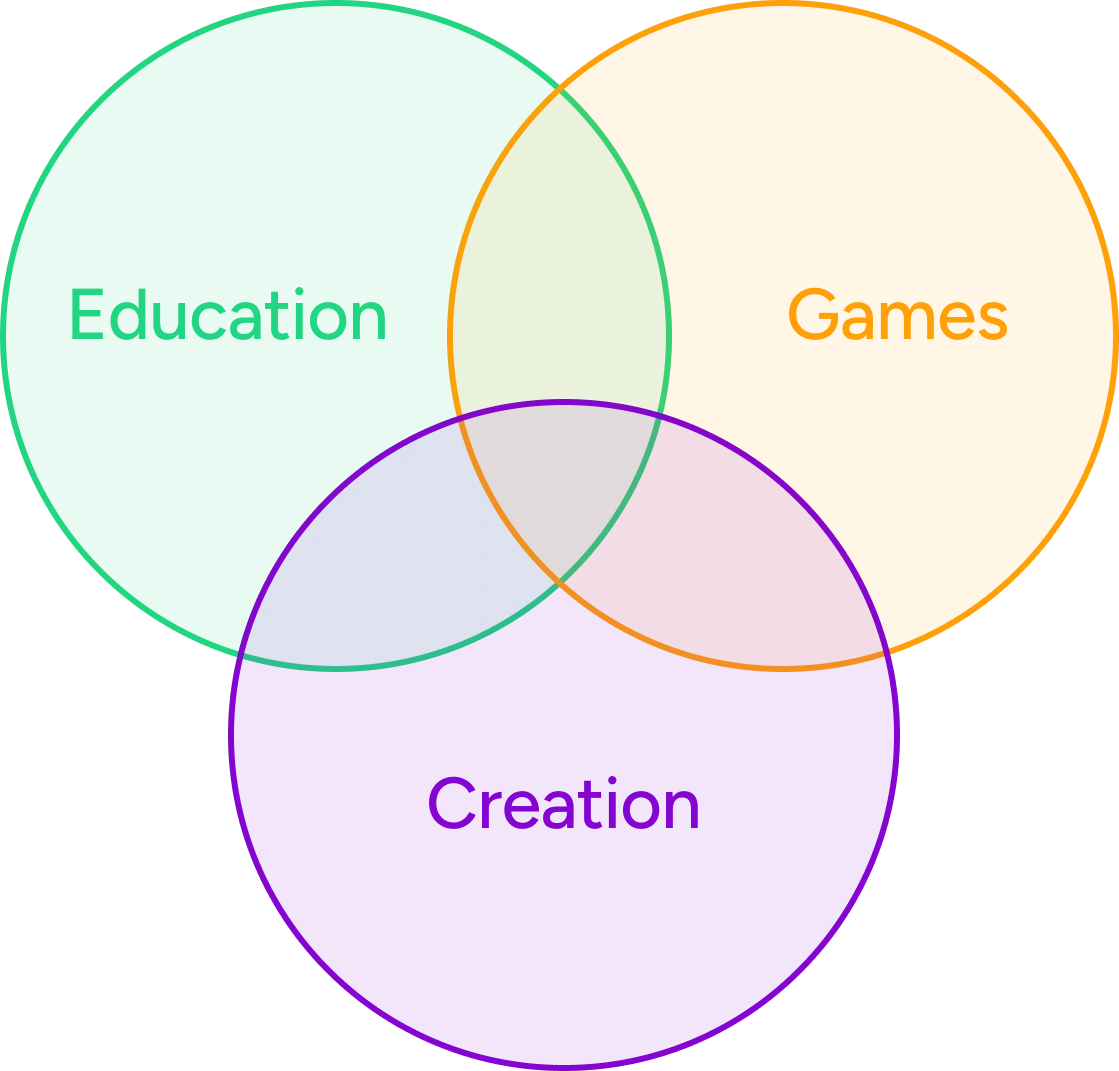
There are actually quite a few examples of organizations that have been successful at the intersection of two of these three spheres. For example, Duolingo is what you get when you merge deliberate education with gamification. It applies badges and streaks and fun animations and characters and progression arcs with a very purposeful educational intent. Minecraft, Fortnite Creative and Roblox are what you get when you merge games and creation communities. In fact, that combination is perhaps the greatest trend in gaming today. And then tools like Scratch and Unity’s online courses are what you get when you combine deliberate education with creation tools. All of these have been very successful at scale. Duolingo has 70 million monthly active users. Scratch has 100 million monthly active users. Fortnite recently surpassed 110 million users playing at the same time!
What might it look like to build something that sits at the intersection of all three of these? Imagine something with the addictive engagement of games, the creation community of a GitHub, and the educational scaffolding of online education providers like Coursera or YouTube.
Network Effects
A network effect is when the value of a product, service, or platform increases with the number of users. The more people who use it, the more valuable it becomes for everyone.
Think of a social network like Facebook, Instagram or LinkedIn. The more people who are on these platforms, the more valuable the platforms are. Network effects businesses go far beyond social networks. For example, one telephone by itself is useless. Two phones creates value. When every home has a telephone, it becomes exponentially more valuable. We see network effects at work with payment systems, with operating systems and the apps built upon them, with Netflix, where the more subscribers there are, the more high quality content they can afford to create, with the number of drivers and passengers on a ride-hailing app, and with marketplaces like eBay and Amazon, where the more buyers there are, the more valuable it is to the sellers, and the more sellers there are, the more valuable it is to the buyers.
Most of the modern internet is built upon network effects. Network effects are the number one reason that these titans of the internet tend to be winner-takes-all. Those who get to scale win.
Almost all of the examples of infinitely scalable online services and communities that I described previously fit the definition of a network effect. The more of your friends are playing games and building UGC, the better the game becomes. The more users on Coursera, the more professors and schools want to offer courses on Coursera. The more code repositories in GitHub, the easier it is to interact with code across all of those hundreds of millions of other repositories. These are ecosystems that get more valuable with every new participant. That's the power of network effects - they don't just scale, they supercharge growth.
Traditional education, however, does not have a network effect. Big classrooms are not what parents hope for when choosing a school. In fact, we just chose a school for our kid precisely because the other option had an 80-child classroom. My four-year-old needs structure. Imagine a 4,000-person classroom. Who would send their kids to that school? This is precisely why MOOCs struggle. They can scale the content, but not the quality of the classroom experience.
So we have a dilemma. On one hand, we've always believed that the best education happens in small, intimate settings. Twenty students to a teacher. Personal attention. Individual feedback. It's why the most prestigious universities pride themselves on their small class sizes.
On the other hand, look at the digital platforms we've just explored. They don't just maintain their quality as they grow - they get exponentially better. Each new GitHub user makes the platform more valuable for everyone. Each new gamer enriches the community. Each new social media user adds to the collective experience.
So here's the question: What if we could do the same thing with education? What if we could create a learning environment that actually improves with scale? Not one that just maintains quality, but one that gets fundamentally better the more people join. Take a moment. Really think about it. What would it look like for an educational platform to be better when millions join than when there is a classroom of twenty? Therein lies the holy grail of infinitely scalable learning.