The Fourth Turning
Introduces the Strauss–Howe cyclical theory of history, explains how a Crisis era arrives roughly every eighty years, and lays out the evidence that we are inside one now.
Published February 12, 2026
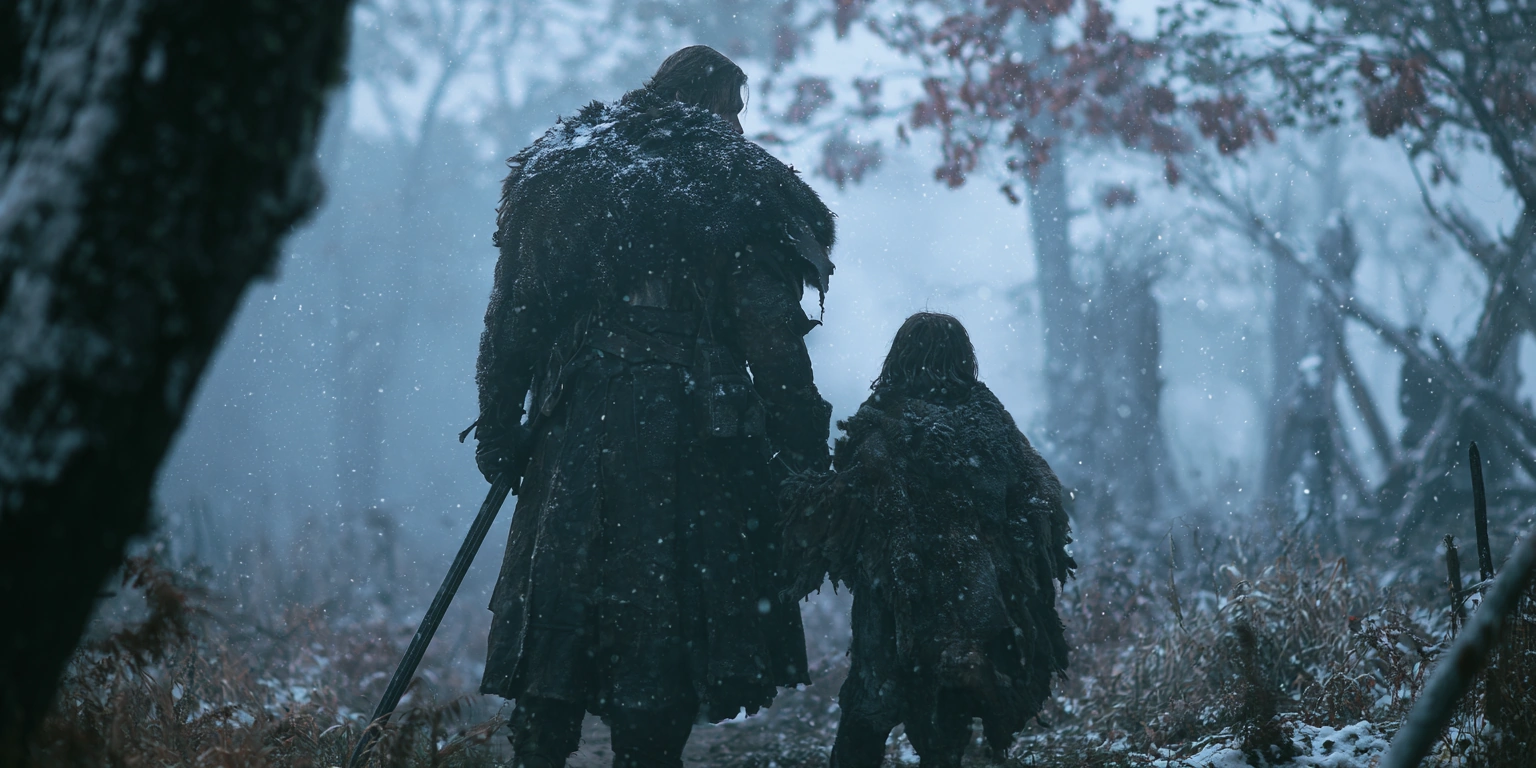
“The temptation of those who don't read history is to think that this time is different.”
— David Brooks
Let's climb back into our time machine for a moment. The year is 1997. The Soviet Union has fallen. The internet is young. Alan Greenspan presides over a soaring stock market. The federal budget is headed toward a surplus. The biggest scandal in America involves a blue dress. It's an era of such peace and prosperity that political scientist Francis Fukuyama famously declared we might have reached "the end of history." It feels like the trajectory is clear. Up and to the right.
In the midst of this, three words appeared: "Winter is coming.” Ned Stark’s words sat at the heart of George R.R. Martin's A Game of Thrones, published in the fall of 1996. "Teach my son the things he needs to know.” They carried readers to an ancient era of castles, swords, and gathering shadows. They were words of fantasy.
But Martin wasn't the only author to spotlight those words. Just five months later, in the winter of '97, a pair of historians wrote them too. “Winter is coming.” Only they weren't writing about a faraway kingdom. They were writing about the near future.
If you had asked someone in the late 1990s what the next thirty years would look like, you probably would have heard some version of the same story: globalization would continue, democracy would expand, technology would steadily improve lives, and conflict, while never gone, would remain contained. It was in this springtime of optimism that William Strauss and Neil Howe published The Fourth Turning, claiming that the mid-2000s would usher in a world-altering international crisis. They offered five examples of possible catalysts for this crisis, not necessarily suggesting that any one of these events would actually occur, but suggesting that they were emblematic of what this winter’s first snow might look like.
Their five examples:
-
Terrorists blow up an airplane, compelling the US to make a declaration of war while rolling back privacy rights in the name of national security.
-
A financial crisis and an impasse over the federal budget leads to a government shutdown, inspiring the president to expand executive powers and exert more control over the federal purse.
-
A pandemic sparks mandated quarantines while the US military is deployed to manage civil unrest.
-
Russia invades a former Soviet state and allies with Iran, causing oil prices to soar.
-
A US state refuses to follow federal law and secedes from the union.
When I read this Prophecy chapter, written in 1997, I sat with my jaw dropped. These were insane, career-killing predictions in 1997. And yet, as Neil Howe puts it in his foreword to his 2023 “sequel”, The Fourth Turning Is Here, “The first four have already happened. The fifth (a succession threat) remains as conspicuously on the table as a pistol in act one of a Chekhov play.”
Even if we were to write off the accuracy of these predictions as coincidence, the more important point is that Strauss and Howe got the prevailing trend right. Over the course of the past decade, we’ve seen a civil insurrection at the US Capitol, the normalization of year-round environmental disasters, the widespread adoption of Turing-tested AI, the formation of a new axis of autocracies, the embrittling of NATO, and an unprecedented weakening of America’s judicial and legislative branches. Howe adds that “surveys today routinely find that roughly half of Americans think a national civil war is ‘fairly’ or ‘very’ likely in the next few years.” China’s president regularly tells his people to prepare for the Hundred Year Storm.
When juxtaposed with 1997's America, the contrast is clear. The era of optimism is over. This is what it looks like when a society unravels toward crisis. To have predicted such a thing in the late nineties, in a booming America, at the so-called "end of history," is extraordinary. Like predicting a hurricane on the clearest, most beautiful of days. How did they predict this? What does it mean for the world ahead? And what does it mean for what we can do to build a better future?
If we can peer into the future a little bit, we might be better able to answer these questions. As Winston Churchill put it, “The farther back you can look, the farther forward you are likely to see.” Let's look back, so that we might see further forward.
History As Cyclical
We live such brief lives. Like a little hourglass, the sand passes and we disappear. Like poppies blossoming in the spring and dying in the winter, we see one season. But history came before us and history continues beyond us. In Game of Thrones, the winter warning doesn’t only allude to meteorological seasons. It alludes to the seasons of history and political economy. It refers to the build-up of tensions during good times, which will inevitably converge on hard times ahead.
In the fiction, there’s only one noble family that has its eye on these seasons of history: the Starks, who take the phrase “Winter is Coming” as their family slogan. Whereas other nobles think about the kingdom’s politics in linear terms, looking at the present state of affairs and where it’s trending, only the Starks think cyclically. They teach their children to do the same and raise those children to survive the inevitable “long winter” ahead. So that, later in the series, when a political winter does indeed come, and when it passes, it isn’t hard to guess who ends up on top.
The historians’ book, The Fourth Turning, might have been a work of academia rather than fantasy, but it concerned itself with the same subject matter: the heartbeat of history and the fate of civilization. Neil Howe and William Strauss, its authors, issue their own winter warning in precisely this same vein. “History is seasonal,” they write, “and winter is coming.” They too are referring to the seasons of political economy. Where other historians and forecasters encourage us to study the nature of this moment, this generation, and chart its trend lines, Howe and Strauss encourage us to think cyclically. They argue that this view of history yields more accurate, and, therefore, more useful, forecasts.
This cyclical conception of history is hardly novel. A civilization in Tuscany 800 years before the Romans identified the pattern tied to the long human lifetime. The Romans gave it its name, the saeculum. On Athena’s temple, the ancient Greeks inscribed, "All human things are a circle.” The Norse conceived of Ragnarök, the end of the world, as a necessary step toward its rebirth. Chinese philosophers saw this same cycle in the eternal dance of yin and yang. The Aztec calendar stone, perhaps history’s most famous circular calendar, mapped entire ages of the world, each destined to end and begin anew.
“What has been done will be done again,” wrote King Solomon in the book of Ecclesiastes. “There is nothing new under the sun.”
The Four Turnings
Howe and Strauss say a great deal about these seasons, with incredibly rich historical detail, but give none so much focus as winter. This is their eponymous “Fourth Turning,” the fourth season. It ends one epoch and begins another. And it is always characterized by a “sharp break”. A crisis.
Each epoch runs roughly 80 to 100 years, the approximate length of a human life. The Romans coined the term saeculum to give a word to this cycle of the long human lifetime. Each saeculum, or cycle, contains four turnings:
- The First Turning: The High (Spring)
- The Second Turning: The Awakening (Summer)
- The Third Turning: The Unraveling (Fall)
- The Fourth Turning: The Crisis (Winter)
These turnings strike like beats in a measure of music. I think of my grandfather tapping his foot and counting time as he taught me the clarinet: "One and TWO and three and FOUR, and one and TWO and three and FOUR..." Each tap, a generation. Each bar of four beats, an epoch. Each bar followed by yet another. The Crisis and the Awakening are what my grandfather would have called "the two" and "the four." They are the "backbeats" that jazz musicians emphasize most. They're the dramatic moments, which give each epoch its structure and character.
The Crisis reshapes our “outer world”, our political and social institutions, while the Awakening reshapes our “inner world”, our culture and values.
Consider the most recent crises in American history. The Glorious Revolution. The American Revolution. The Civil War. World War II. Each arrived roughly eighty years after the last. Each catalyzed a total restructuring of our political and social institutions. They were archetypal Fourth Turnings, so violent and so dramatic that our entire way of life was altered. The world order broke down and was replaced.
Following the Fourth Turning Crisis, we have the High. These are stable periods.
Then there are the Awakenings in between Crises, challenging whatever cultural values and norms had become entrenched in the institutional upheaval of the Crisis. After the colonies won their independence, for example, came the transcendentalists, abolitionists, utopians, first-wave feminists, and new prophetic religions, all of them working, together and apart, to reshape their country’s moral and spiritual character. Perhaps the most illustrative Awakening for us is the one that followed WWII. Howe and Strauss observe that:
In the late 1950s, forecasters widely predicted that America's future would be like Disney's Tomorrowland. The experts first saw well-mannered youth, a wholesome culture, an end of ideology, an orderly conquest of racism and poverty, steady economic progress, plenty of social discipline, and uncontroversial Korea-like police actions abroad.
These predictions came from forecasters who viewed history linearly. If those forecasters had instead taken the cyclical view, perhaps they would not have been so surprised by the rude Awakening that followed: Vietnam-war protests from unkempt hippies, Woodstock, the Civil Rights Movement, second-wave feminism, New Age spiritualism, and the Summer of Love. Classic Awakening rebellion.
Between these dramatic Crisis and Awakening beats are the “High” and the “Unraveling.” The High comes immediately after the Crisis, giving society a strong sense of order, an unshakeable trust in institutions, a feeling of unity. A victorious post-WWII America is the picture-perfect image of such a High.
But the High leads to an Awakening, and the Awakening leads to an Unraveling. By the time an epoch reaches its Unraveling, its Third Turning, the ascendent generation has forgotten its parents’ victories, has rejected its parents’ values, is disillusioned with the state of the world, and puts little trust in its aging institutions. Society’s once-strong fabric unravels in a state of affairs bound to usher in Crisis.
Our Unraveling
Looking back at Unravelings across the centuries, most recently in the 1760s, 1850s, and 1920s, Howe and Strauss describe the archetypal unraveling with the sort of precision and detail that is classic of their writing:
During each of these periods, Americans celebrated an ethos of frenetic and laissez-faire individualism… yet also fretted over social fragmentation, epidemic violence, and economic and technological change that seemed to be accelerating beyond society's ability to absorb it…
During each of these periods, an aggressive moralism darkened the debate about the country's future. Culture wars raged, the language of political discourse coarsened, nativist (and sectional) feelings hardened, immigration and substance abuse came under attack, and attitudes toward children grew more protective.
During each of these periods, Americans felt well-rooted in their personal values but newly hostile toward the corruption of civic life. Unifying institutions, which had seemed secure for decades, now felt ephemeral. Those who had once trusted the nation with their lives were growing old and dying. To the new crop of young adults, the nation hardly mattered. The whole res publica seemed on the verge of disintegrating.
During each of these previous Third Turnings, Americans felt as if they were drifting toward a cataclysm.
And, as it turned out, they were.
Our present moment is not unique. It is not special. It is the perfect embodiment of an age-old archetype. It is a classic entry into the early Fourth Turning.
The patterns Strauss and Howe applied were already taking shape in their first book, Generations. They began writing it in the late 1980s and published it in 1991. They wrote it as the Berlin Wall was falling, with American confidence at its postwar peak. Despite this era of optimism, in the book’s preface, they wrote: "No one, for example, can foretell the specific emergency that will confront America during what we will call the Crisis of 2020." They were peering more than thirty years into the future. That's the equivalent of us, today, naming a crisis in the late 2050s. They continued: "The nation's public life will undergo swift and possibly revolutionary transformation." They could not foretell the specifics. But the shape and the timing were called with the precision of Hari Seldon's psychohistory in the Foundation series. When you see the patterns, and trust them, the future comes into focus.
From the Glorious Revolution to the American Revolution, 72 years elapsed. Abraham Lincoln began the Gettysburg Address with his famous, “Four score and seven years ago”, as he described the 87 years that had elapsed since the American Revolution. A further 78 years elapsed from that address to Pearl Harbor and America’s entry into WWII. And we have just celebrated WWII’s 80th anniversary.
We are right on time.
The Five Drivers
I want to turn to another book. It is rather close to home, as it was quite literally written in my living room. Well, my dad wrote it as we all huddled together in his living room in COVID, hiding from a world that felt like it was indeed unraveling.
My dad had started writing The Changing World Order many years earlier. His goal was originally to finish it ahead of the 2020 election. It took another two years. For years, he had been talking about the “Five Big Forces” that push us toward crisis.[^1]
I remember sitting in the living room with him on January 6, 2021, next to a stack of books with titles like The Great Leveler: Violence and the History of Inequality. The TV was on. The Capitol was being stormed. It was like watching his book unfold on live television. "It is happening," we both knew.
The five forces, as he describes them:
- The creation of enormous amounts of debt as countries use their own central banks to print massive piles of money, which they then lend to themselves.
- Big domestic conflicts within countries prompted by growing wealth and values gaps, leading to the emergence of populists on the left and the right, at war with each other.
- Big international conflicts between countries stemming from the rise of nations powerful enough to challenge the existing powers and world order.
- Acts of nature like droughts, floods, and pandemics (now exacerbated and accelerated by climate change).
- Technological innovations that can do a great deal of good but can also cause financial bubbles and busts while accelerating the other four forces.
Like Strauss and Howe's cycles, these forces stretch beyond our own lived memory. They are not new. We cannot use our lived experience to register them. We must use history to understand them. As my dad describes, together they cause "radical, typically unexpected changes that haven't happened in one's own lifetime but have happened many times throughout history." They have appeared together at every major civilizational turning point in modern history (in the 1760s, the 1850s, the 1930s) and each time, the pattern has been the same: Debt builds. Domestic divisions sharpen. Great powers rise to challenge incumbents. Nature delivers shocks. New technologies disrupt the foundations.
Here is where each force sits today.
The debt. US gross national debt has crossed thirty-nine trillion dollars, a number so large it has lost the power to alarm. Debt held by the public now exceeds the entire annual output of the American economy. The last time that happened was 1946, in the immediate aftermath of World War II, and we are on track to break that record within the decade. The federal government now spends roughly $1.33 for every dollar it collects. Stabilizing this would require ten trillion dollars in deficit reduction, a number for which no plan, from either party, currently exists. We are not approaching the conditions my dad describes. We are inside them.
The domestic conflict. Wealth concentration in America has returned to levels last seen in the Gilded Age: fewer than ten percent of families now hold roughly seventy percent of the nation's wealth. Trust in nearly every major institution from Congress to the press, the courts, and the presidency, sits at or near historic lows. The divide has metastasized into something darker than ordinary disagreement. As of late 2025, nearly a third of Americans say violence may be necessary to put the country back on course. And that thinking has begun to manifest. The sitting president has had multiple assassination attempts, a state legislator and her husband were assassinated in their home, a governor's residence was firebombed with his family sleeping inside, a major healthcare CEO was murdered on the streets of Manhattan, and a prominent conservative activist was shot dead in front of a crowd of college students. This is a country whose two halves have begun to look at each other the way warring tribes do and whose citizens have started to act on it.
The international conflict. The most reliable structural cause of great-power war is a rising power closing on an incumbent. Harvard's Graham Allison studied sixteen such cases across five hundred years. Twelve ended in war. We are in the thirteenth. China's economy is the largest in the world by purchasing power. It produces more steel than the rest of the world combined, more ships, more solar panels, more electric vehicles. Its navy passed America's in ship count around 2020 and the gap is widening. Xi Jinping has directed the People's Liberation Army to be ready to take Taiwan by 2027. He tells his people to prepare for the "Hundred Year Storm."
Around China, a new axis has formed. Foreign policy analysts call it CRINK: China, Russia, Iran, and North Korea. They are bound less by ideology than by a shared interest in dismantling the American-led order. Russia now fights its war on Iranian-designed drones and North Korean artillery shells. The US is at war with Iran. This is not the warm peace of the 1990s. This is a cold war with hot edges, already underway, and the weapons grow more lethal every year.
The acts of nature. In 2025, the US experienced twenty-three separate billion-dollar climate disasters, the third-highest year on record (behind 2023 and 2024). Global projections range from 216 million to over a billion climate migrants by 2050, driven by drought, crop failure, and rising seas. Hungry people move. COVID killed at least 7 million people. As my dad says, “We should remember that acts of nature have killed more people than wars and toppled more domestic and world orders than anything else.” The forecast is not a return to stability. It is more.
The technology. And then there is the fifth force, the one that accelerates the others. American hyperscalers are spending hundreds of billions of dollars a year on AI. The seven largest US companies (all of them AI bets) now make up nearly forty percent of the S&P 500, a concentration that exceeds the dot-com era. A financial correction of historic proportions is one possible outcome. It may also be the least of our concerns. In annual surveys, the median AI researcher puts the probability of human extinction from advanced AI at around five percent. Forty percent of employees globally now fear losing their jobs to AI. And then there are the cyber and geopolitical dimensions. A Chinese state-sponsored hacking operation, named Volt Typhoon, has maintained persistent access inside American water, energy, transportation, financial and communications infrastructure for at least five years. As one US Air Force cyber commander put it in 2025: "they're setting the conditions to execute destructive cyberattacks, should there be a regional conflict in the Pacific over Taiwan." Meanwhile, technology could also lead to mass productivity. It is both an amplifier of all of the other crises, as well as our best hope of solving them.
Any one of these forces, on its own, a society may be able to absorb. A Fourth Turning is what happens when all five arrive at once. And every one of them has now reached crisis magnitude simultaneously.
Stark Family Advice
As Mark Twain put it, “It is not worthwhile to keep history from repeating itself, for man’s character will always make the preventing of the repetitions impossible.” Or as Howe and Strauss put it, “A Fourth Turning can be long and difficult, brief but severe, or (perhaps) mild. But, like winter, it cannot be averted. It must come in its turn.”
Strauss and Howe tell us when winter comes. My dad tells us what winter is made of. Both point at the same thing: be aware, and prepare. Each epoch of history has moved society forward. My dad draws history as a spiral, climbing upward. It also describes the progression of our lives. We make progress, we falter, we learn, and then we progress upward again. At any given moment in the spiral, you're either falling or failing or about to be. But step back and look at the line the squiggle made, and the arc is unmistakable. Every cycle moves us further up and to the right. The question is whether we can keep that going.
That's how I view our moment. Crisis might be inevitable, but the long-term outcome isn’t. Whether we descend into chaos and decay or reboot and rebuild is up to us. The chapters ahead will describe where we are today and where we may go tomorrow. But the important thing is to remember that we can control the outcome.
What would you do if the fate of the world depended on it?
That is the purpose of everything I write. To find the lever we must press.
The Stark family understood that there is nothing more important than preparing our children, not just to survive the winter but to come out on top. The quality of their education, the opportunities we create for them, the technology we make available to them, the training we offer them: these will determine the length of our winter and what our world looks like on the other side of it. We have a responsibility to prepare our children for it. Not just my children and your children, but our children: the world’s 3 billion young people under the age of 25.
As Howe and Strauss put it: “We cannot stop the seasons of history, but we can prepare for them. Right now… we have eight, ten, perhaps a dozen more years to get ready. Then events will begin to take choices out of our hands. Yes, winter is coming, but our path through that winter is up to us.”
As Ned Stark put it: “Teach my son the things he needs to know. Winter is coming.”