How We Work
Establishes that education must mirror the multidisciplinary, collaborative, tool-driven shape of today's workforce, not the rows-of-desks shape of the industrial classroom.
Published May 14, 2026
PRINCIPLE: The most effective education mirrors the workforce, not the classroom
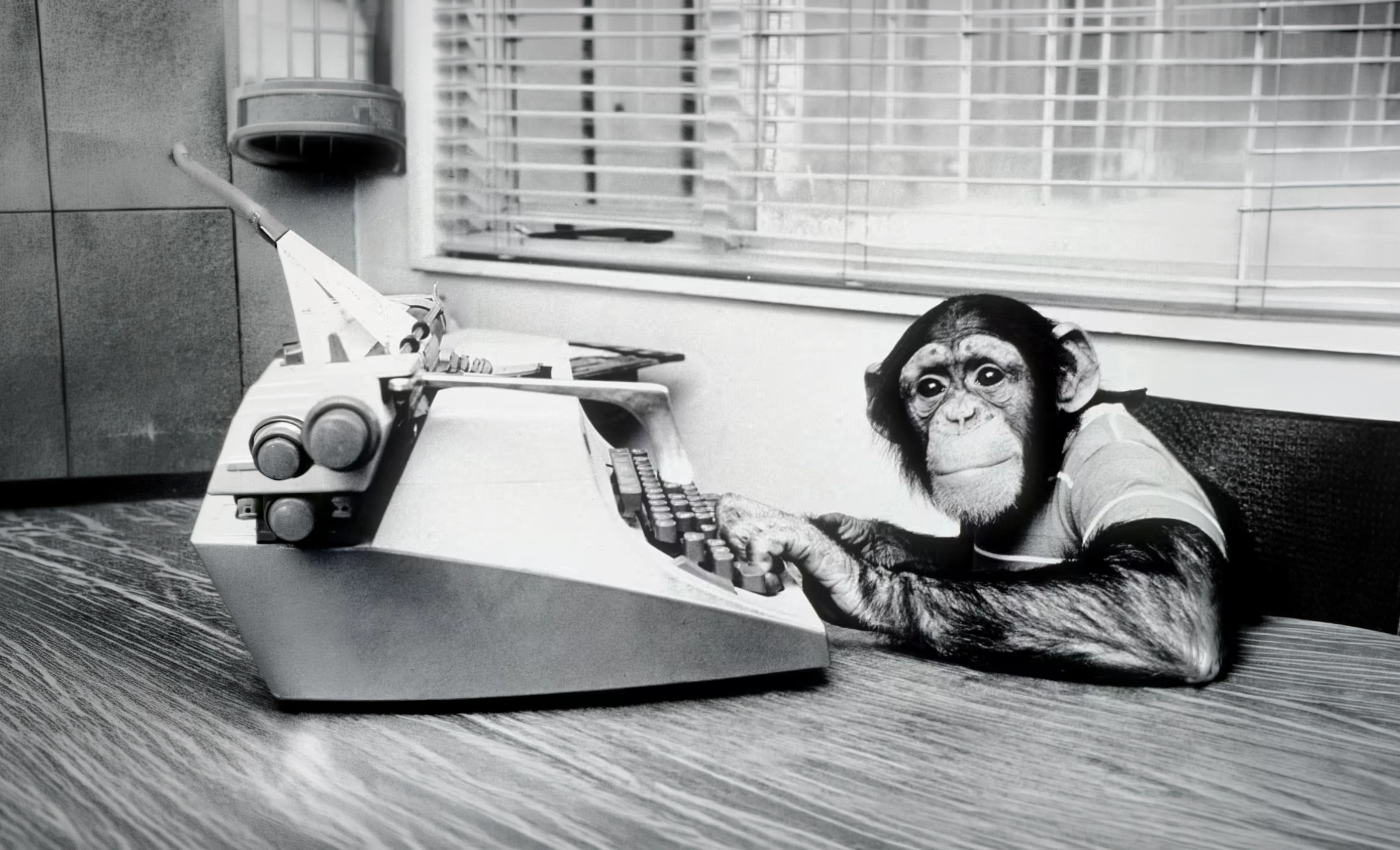
Even as recently as a handful of decades ago, the knowledge worker played a clerical role. Rows of office workers, each with a typewriter, passed paperwork from one place to another, processing manual calculations with a slide rule so that those calculations could be passed along to another person to use in their own calculations. These rows and columns of humans were like a human spreadsheet. Their offices were the paragon of efficiency, lunch breaks taken with clockwork regularity, polished linoleum floors echoing the clatter of typewriters and the ringing of rotary phones, managers walled off by walnut doors, all of it reflecting a hierarchy that valued precision above innovation. The workers were the computers. Memos were filed.
It was these soulless 9 to 5 jobs of the 1950s that led their children to rebel and become the flower children of Woodstock. Technology evolved, and work evolved along with it.
Back to the future
Today, every person can have their own army of those diligent workers toiling away at the speed of light with a few keystrokes. Excel. Deep Research. Agents. Platforms like Mechanical Turk. These are all platforms that can deliver ideas and wares to billions of people in a few clicks.
A laptop has the potential to power the equivalent of entire enterprises of yesterday.
So, what does it look like to work in these innovative, high-paying software-centric jobs in everything from startups to industry titans like Google? We have to be able to visualize what’s needed for these jobs if we’re going to prepare youth for them.
These offices, when we even have them, are open spaces with breakout rooms that have glass walls that proclaim transparency, covered with the scribbles of team brainstorms, lined with post-its. In huddle rooms, the valuable employees are the ones who can communicate clearly, who can build upon the ideas of others, who can synthesize reams of data to inform a strategy, and who can quickly deliver on the ideas that are born upon those post-it notes.
On average people spend 80% of their day on email. 6 hours a day. That is a statement of how collaborative our work is. This collaboration extends across multiple tools, from Slack and project management software like Jira to Google Docs, GitHub and Figma. Proficiency with these tools is as essential to today's work as Word was to the 1990s office.
These tools represent the reality that today’s work is also about working across vastly different disciplines, each one tied into one orchestration that results in the products that drive our lives. Marketing and product. Design and engineering. Strategy and sales. Finance and project management. They weave together in a multi-colored tapestry that is far more integrated than the workforce of our parents. That statement is true regardless of what generation you are in, because it is only becoming truer every year.
Like a full-stack engineer - that cherished engineer that can navigate an entire tech stack - often the most valuable employees are the ones who can traverse these disciplines. Those who can navigate Excel and Photoshop with equal fluency, who can mock up their ideas in Figma, write their own copy, clean up a dataset and string together charts to visualize the company’s growth bottlenecks, who can hop into HubSpot to comment on a social media strategy, help an engineering team brainstorm a shortcut to get them the much-needed feature, who can code their own landing page when the launch depends on it, and then optimize their email funnel: these are the gems in the modern workforce. They understand the challenges of their peers. They become thought partners in solving them. They become the most valuable members of a team, the ones who drive forth organizations. They become the managers, the leaders.
Training this at an early age is important, especially as people are developing their interests. Even for those who specialize to work in a larger organization, the opportunity to work in such a collaborative environment is central to discovering the places that make you come alive.
Yet cohorts of university graduates enter the workforce completely unprepared to work this way. Most have spent four years being educated in rows in classrooms with their linoleum floors. Most have never had an experience that bears any resemblance to the working world of today. Traditional education, while valuable in many ways, often emphasizes theory over practice.
Perhaps I am being harsh, but the fact that university enrollment has declined by almost 2 million students in the last decade is a statement that college is failing at something important. Yes, there are many factors at play, like the rising cost of education. But it’s also a reflection of the fact that universities are increasingly seen as failing to provide students with the skills necessary to thrive in the fast-evolving working world.
Our schools have to look like the workforce that we are preparing them for. They need to embrace collaboration across disciplines, harness technology as a tool rather than a subject, and measure success by capabilities rather than credentials. The gap between our educational system and the realities of modern work has become a chasm that too many students fall into after graduation. What if we could reimagine education from the ground up?